 how-to
Non-Disruptive Exterior Cleaning for Hospitals
Table of Contents
- Why Cleaning and Disinfection Matter for Patient Safety
- Hospital Cleaning Risk Assessment: Identifying Exterior Hazards
- Cleaning Versus Disinfection: What Your Facility Needs
- Exterior Cleaning Method Comparison: Traditional Versus Modern Approaches
- Hospital Exterior Cleaning Schedule: Planning Around Patient Care
- Drone Facade Cleaning: Step-by-Step Implementation
- High-Touch Surfaces and Contamination Risks in Hospital Exteriors
- Managing Noise, Overspray, and Operational Disruption
- Frequently Asked Questions
Last Updated: October 11, 2026
Why Cleaning and Disinfection Matter for Patient Safety
Hospital environments demand the highest standards of cleanliness and hygiene. Patient safety depends on it. This is why non disruptive exterior cleaning for hospitals has become essential for modern healthcare facilities.
The exterior of a hospital building is not separate from patient care. It's the first line of defense against environmental contamination. Dirt, algae, bird droppings, and pollutants accumulate on facades, entrances, and walkways.
A clean hospital exterior protects patient outcomes. It also improves staff morale and sends a message to the community that the facility maintains rigorous hygiene standards.
Hospital Cleaning Risk Assessment: Identifying Exterior Hazards
Before choosing a cleaning method, you need to understand what risks your facility faces. A proper hospital cleaning risk assessment identifies contamination sources and determines which exterior surfaces pose the greatest threat to patient safety.
Common exterior hazards include:
- High-traffic entrances and walkways, foot traffic brings dirt, moisture, and microbes indoors
- Parking areas and loading zones, vehicle exhaust deposits pollutants on adjacent surfaces
- HVAC intake vents and grilles, contaminated air can be drawn into climate control systems
- Window sills and ledges, accumulate dirt and organic matter that support microbial growth
- Drainage areas and gutters, stagnant water creates breeding grounds for pathogens
- Exterior walls near patient rooms, contamination can migrate through gaps and cracks
The assessment should also consider your facility's specific vulnerabilities. Is your hospital in an urban area with high pollution? Near construction sites? In a region with heavy rainfall or algae growth? These factors influence how quickly surfaces become contaminated and which cleaning methods work best.
Document findings in writing. This creates a baseline for measuring improvement and helps justify cleaning investments to leadership.
Cleaning Versus Disinfection: What Your Facility Needs
Many facility managers confuse cleaning with disinfection. They are not the same process, and understanding the difference is critical for effective hospital exterior maintenance.
Cleaning removes visible dirt, dust, and organic matter from surfaces using water and detergent.
Disinfection uses chemical agents or other methods to kill microorganisms on already-clean surfaces. It targets bacteria, viruses, and fungi that pose infection risks.
For hospital exteriors, the choice depends on surface type and contamination level.
The key insight most guides miss: over-disinfecting exterior surfaces wastes resources and can damage building materials.
Exterior Cleaning Method Comparison: Traditional Versus Modern Approaches
Your facility has several options for non disruptive exterior cleaning for hospitals. Each method has distinct advantages and limitations.
Scaffolding and Manual Abseiling
Scaffolding and abseiling (rope access) have been standard for decades. Workers use ropes and harnesses to access high facades and perform manual cleaning with brushes, pressure washers, and chemical treatments.
Advantages:
- Proven track record with experienced crews
- Flexible, can adapt to complex building shapes
- Workers can perform detailed inspection while cleaning
Disadvantages:
- High work-at-height safety risks despite precautions
- Requires extensive setup time and site preparation
- Disrupts hospital operations during installation and removal
- Labor-intensive and costly for large facilities
- Requires ongoing insurance and worker safety certifications
For hospitals, the operational disruption is significant. Scaffolding blocks patient views, limits parking access, and creates noise during setup and takedown.
Pressure Washing and Chemical Treatment
Pressure washing uses high-pressure water jets to remove dirt and algae. Chemical treatments can be applied before or after washing to enhance cleaning or provide disinfection.
Advantages:
- Fast for large flat surfaces
- Effective at removing heavy buildup
- Relatively lower cost than abseiling
Disadvantages:
- Creates noise and water overspray that disrupts operations
- Can damage delicate building materials and caulking
- Runoff may contain chemicals or debris that require containment
- Requires extended drying time before occupants can use entrances
- Less precise for high-touch surfaces and detailed areas
Hospitals find pressure washing problematic because the noise and water spray interfere with patient care, especially in areas near windows and entrances.
Autonomous Drone Technology
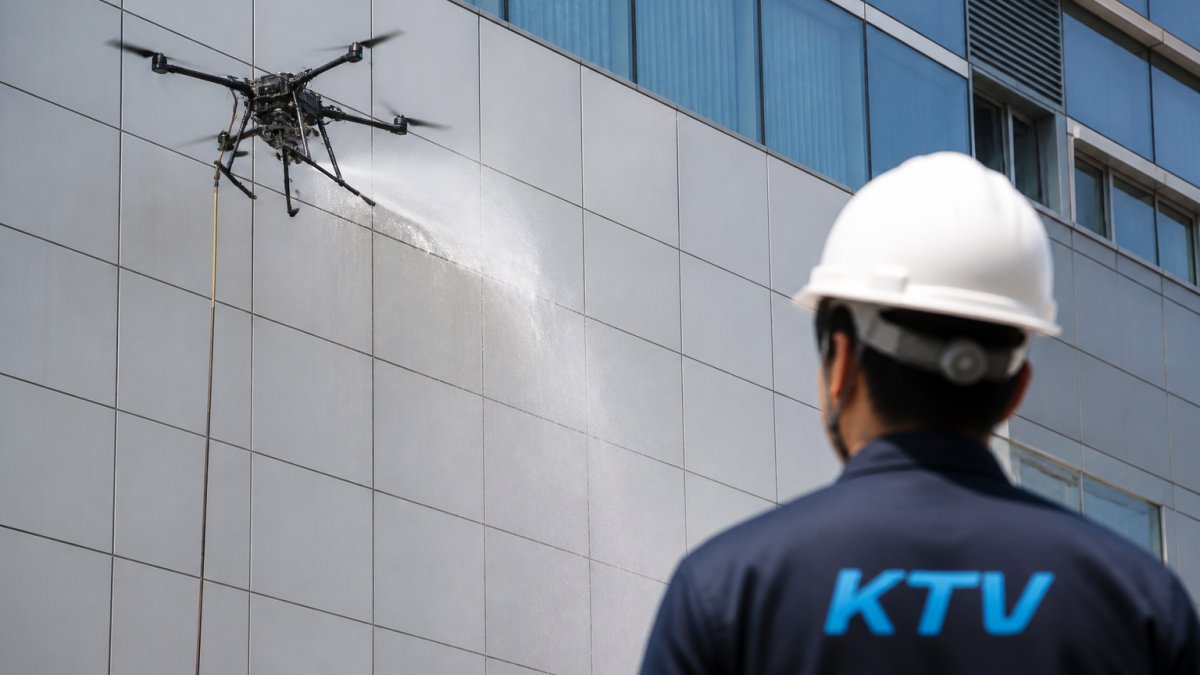
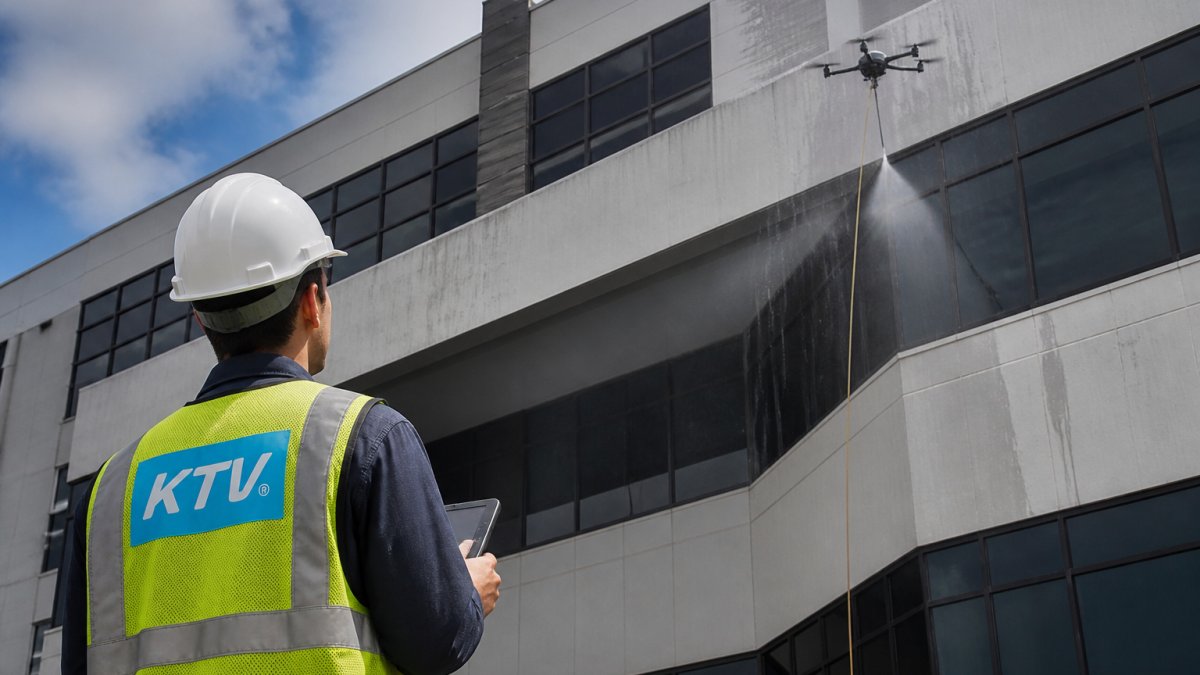
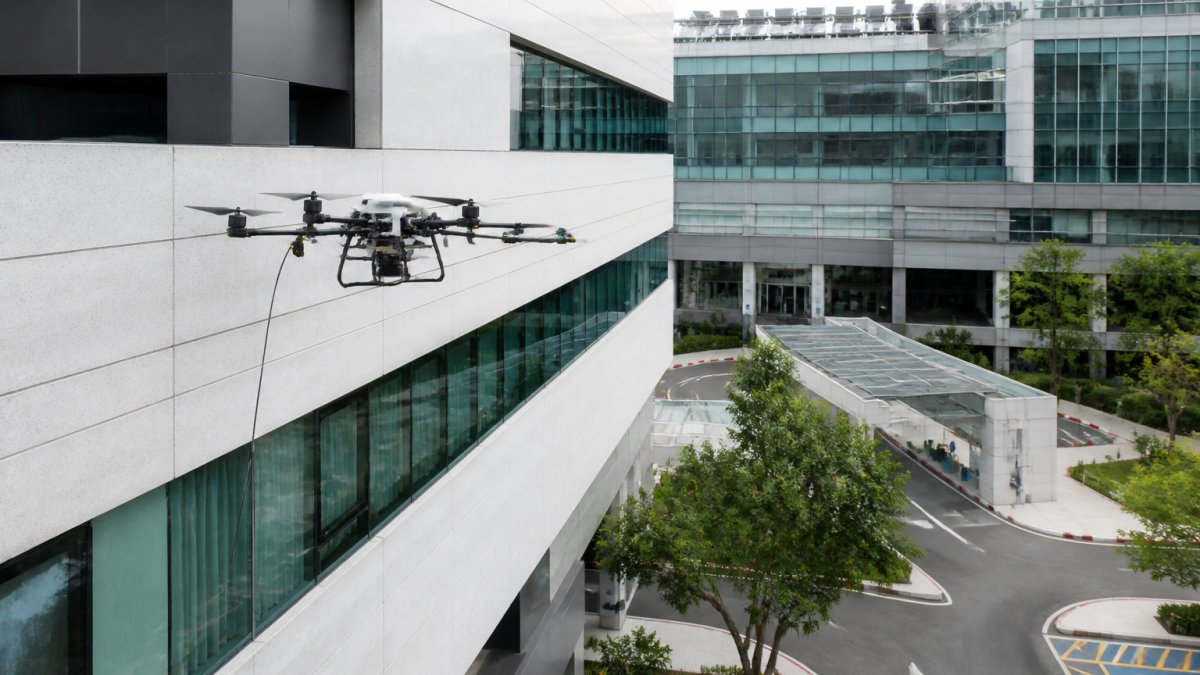
Modern autonomous drones equipped with cleaning systems can access building facades without scaffolding, abseiling, or ground crews. Drones apply water, cleaning agents, or disinfectants through precision nozzles while maintaining safe distance from the building.
Advantages:
- Minimal operational disruption, no ground setup or noise
- Eliminates work-at-height safety risks entirely
- Faster deployment and completion than traditional methods
- Precise application reduces chemical use and overspray
- Can access complex geometries and hard-to-reach areas
- Provides digital documentation and verification of work
Disadvantages:
- Requires clear weather conditions and adequate airspace
- Initial investment higher than one-off pressure washing
- Operator must be trained and certified
- Limited by battery life on very large buildings
For hospitals, autonomous drones represent a breakthrough. KTV Working Drone Thailand's technology delivers non disruptive exterior cleaning for hospitals by operating outside clinical hours and producing minimal noise or disruption to patient care.
Hospital Exterior Cleaning Schedule: Planning Around Patient Care
Timing is everything in hospital facility maintenance. Your cleaning schedule must protect patient safety and operational continuity while ensuring the building stays clean.
Start by mapping your facility's daily rhythm. When are peak admission and discharge times? When do staff shift changes occur? When is foot traffic lowest?
Many hospitals schedule exterior cleaning early morning (5-7 AM) or late evening (7-9 PM) when patient activity is lowest.
For non disruptive exterior cleaning for hospitals, consider these scheduling principles:
- Entrance and walkway cleaning, schedule during lowest foot traffic periods
- High-touch surface disinfection, coordinate with housekeeping staff to avoid conflicts
- Facade cleaning, can occur during any hour if the method produces minimal noise
- Parking area maintenance, schedule when patient drop-off and visitor parking are lightest
Document your cleaning schedule and share it with clinical staff, security, and facilities teams. This prevents confusion and allows staff to plan around the work.
Drone Facade Cleaning: Step-by-Step Implementation
Autonomous drone technology offers a practical path to non disruptive exterior cleaning for hospitals. Here's how to implement it effectively.
Pre-Cleaning Assessment and Safety Planning
Before deploying drones, conduct a thorough site assessment. Identify obstacles, power lines, antenna systems, and other hazards.
Work with your facilities team to map the building's exterior. Document high-touch surfaces, contaminated areas, and zones requiring disinfection.
Establish a safety perimeter around the building. Drones operate within a defined airspace, typically 50-100 meters from the structure. Ensure the area is clear of people, vehicles, and obstacles.
Operational Scheduling and Access Control
Coordinate with hospital operations to select a cleaning window that minimizes disruption. Early morning or late evening works best for most facilities. Avoid times when ambulances are arriving or departing, and coordinate with emergency department staff.
Brief security and reception staff on the drone operation. They should know:
- Duration of the cleaning operation
- Which building areas are affected
- When the work will be completed
- Who to contact if issues arise
Establish clear communication protocols. The drone operator needs direct contact with facilities management in case unexpected issues occur, weather changes, equipment concerns, or safety questions.
Restrict ground-level access beneath the drone's flight path. This prevents accidental contact and ensures worker safety. Use barriers or signage to keep staff and visitors away from the work area.
Execution with Minimal Disruption
Autonomous drones operate quietly compared to pressure washers or helicopters. The system delivers cleaning solution through precision nozzles, targeting specific surfaces without overspray or runoff issues.
The drone moves systematically across the facade, section by section. Operators monitor progress in real time and adjust as needed.
During execution, maintain the safety perimeter and monitor weather conditions.
The precision of autonomous drones means no water damage to windows, landscaping, or parked vehicles. Cleaning agents are applied only where needed, reducing chemical runoff and environmental impact.
Documentation and Verification
When the cleaning is complete, the drone system automatically generates digital records. These include:
- High-resolution photographs of cleaned surfaces
- Timestamp data showing when each area was treated
- GPS coordinates and flight path documentation
- Chemical application records if disinfectants were used
This documentation serves multiple purposes. It provides proof of service for compliance audits, creates a baseline for future cleaning cycles, and generates the independently verifiable ESG data that many healthcare organizations need for sustainability reporting.
Store digital records in a secure system accessible to facilities management, compliance officers, and auditors. This supports regulatory compliance and helps justify cleaning investments to hospital leadership.
High-Touch Surfaces and Contamination Risks in Hospital Exteriors
High-touch surfaces at hospital entrances pose specific infection risks. These areas require more frequent cleaning and disinfection than general facade surfaces.
Identify all high-touch surfaces at your facility:
- Door handles and push plates
- Handrails and grab bars
- Intercom buttons and access panels
- Window frames at entry areas
- Bench seating in waiting areas
- Parking validation machines
These surfaces accumulate bacteria and viruses from hundreds of people daily. They become vectors for cross-contamination if not cleaned regularly. Standard cleaning removes visible dirt, but disinfection is needed to eliminate pathogens.
For non disruptive exterior cleaning for hospitals, high-touch surfaces should be disinfected at least weekly, more frequently during illness outbreaks.
The advantage is that high-touch surface disinfection can happen during operating hours without affecting patient care. The drone works outside, away from clinical areas, while the building operates normally inside.
Managing Noise, Overspray, and Operational Disruption
Traditional exterior cleaning methods create operational challenges for hospitals.
Water overspray from pressure washing creates additional problems.
Autonomous drone cleaning eliminates these issues. The system produces minimal noise, typically 70-75 decibels, comparable to normal conversation.
For hospitals, this means cleaning can occur without disrupting patient care, clinical operations, or visitor experiences.
The reduced chemical use also benefits the environment.
Documentation of minimal disruption is valuable for hospital administrators.
Hospital facility managers face a real challenge: maintaining clean, safe building exteriors while protecting patient care operations.
Traditional methods like scaffolding and pressure washing create disruptions that hospitals struggle to manage.
Get a quote from KTV Working Drone Thailand and discover how autonomous drone technology can transform your facility's exterior maintenance program.
Frequently Asked Questions
How can hospitals clean building exteriors without disrupting patients?
Schedule exterior cleaning during off-peak hours, typically early morning or late evening when patient activity is minimal. Use low-noise, low-odor methods such as autonomous drones or chemical-free cleaning systems. Establish clear access controls to prevent foot traffic near active clinical areas. Coordinate with operations staff to time work around emergency access routes and high-traffic periods. Autonomous drone technology eliminates the need for scaffolding, abseiling teams, and ground-level equipment, reducing operational disruption significantly compared to traditional methods.
What precautions should be taken before cleaning a hospital exterior?
Conduct a hospital cleaning risk assessment to identify high-touch surfaces, entry points, and areas where germs and contaminants accumulate. Evaluate weather conditions, structural integrity, and potential runoff paths. Ensure infection-prevention protocols are in place, including containment of cleaning runoff to prevent cross-contamination. Verify that cleaning staff and equipment operators understand healthcare facility safety requirements. Document baseline conditions and establish a cleaning schedule that aligns with patient care operations. Confirm that all equipment meets healthcare facility standards for environmental hygiene and surface disinfection.
Can drones clean hospital windows and exterior walls effectively?
Yes, autonomous drone technology can clean hospital windows, exterior walls, and facade surfaces safely and effectively. Drones eliminate work-at-height risks associated with scaffolding and manual abseiling, reducing liability and safety hazards. They deliver chemical-free cleaning through water-based methods, protecting both the building envelope and the healthcare environment. Drones can access difficult-to-reach areas without disrupting patient care or requiring ground-level equipment staging. The process allows hospitals to maintain cleanliness standards without prolonged operational disruption.
How should hospitals schedule exterior cleaning around patient care?
Develop a hospital exterior cleaning schedule that accounts for peak clinical hours, emergency access requirements, and patient movement patterns. Coordinate with facility management and clinical staff to identify optimal windows for work. Schedule non-disruptive cleaning methods during nights, weekends, or planned maintenance periods when possible. For urgent cleaning, use low-noise, low-odor approaches that minimise disturbance to patient environments. Document the schedule in advance and communicate it to all relevant departments. Monitor actual operations against the plan to identify any disruptions and adjust future scheduling accordingly. Autonomous methods allow more flexible scheduling since they require minimal ground-level personnel and equipment.