 ultimate-guide
Benefits of Autonomous Building Facade Cleaning
Table of Contents
- Why Autonomous Building Facade Cleaning Changes the Economics of High-Rise Maintenance
- Drone Facade Cleaning vs Traditional Methods: A Practical Comparison
- How Facade Cleaning Safety Improves When Workers Leave the Rope
- Autonomous Capabilities and Wall-Climbing Mechanisms in Building Facade Cleaning Robots
- Sustainable Building Maintenance: Water, Chemicals, and Carbon Reductions
- What Facility Managers Should Evaluate Before Choosing a Provider
- Conclusion: Matching the Right Cleaning Method to Your Building
- Frequently Asked Questions
Last Updated: October 7, 2026
Why Autonomous Building Facade Cleaning Changes the Economics of High-Rise Maintenance
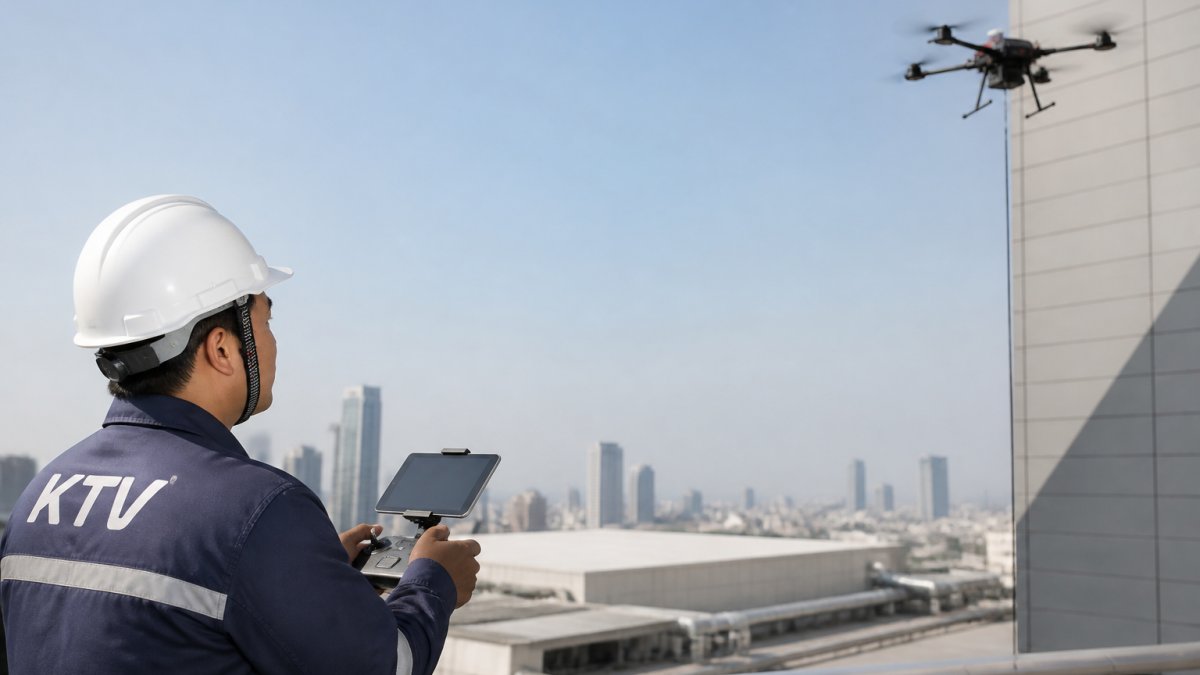
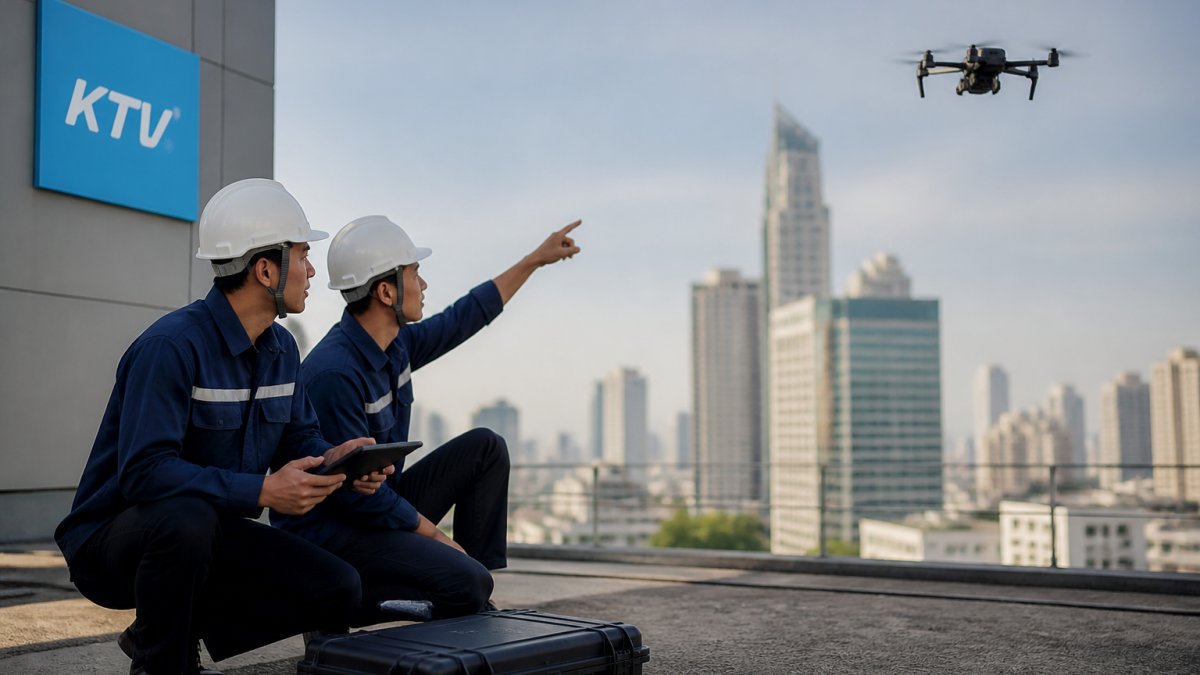
Autonomous building facade cleaning replaces rope access crews and scaffolding with robotic systems that attach to the wall and clean without anyone leaving the ground. At KTV Working Drone Thailand, facility managers move away from manual abseiling not because the cleaning looks better, but because the risk and cost profile changes entirely.
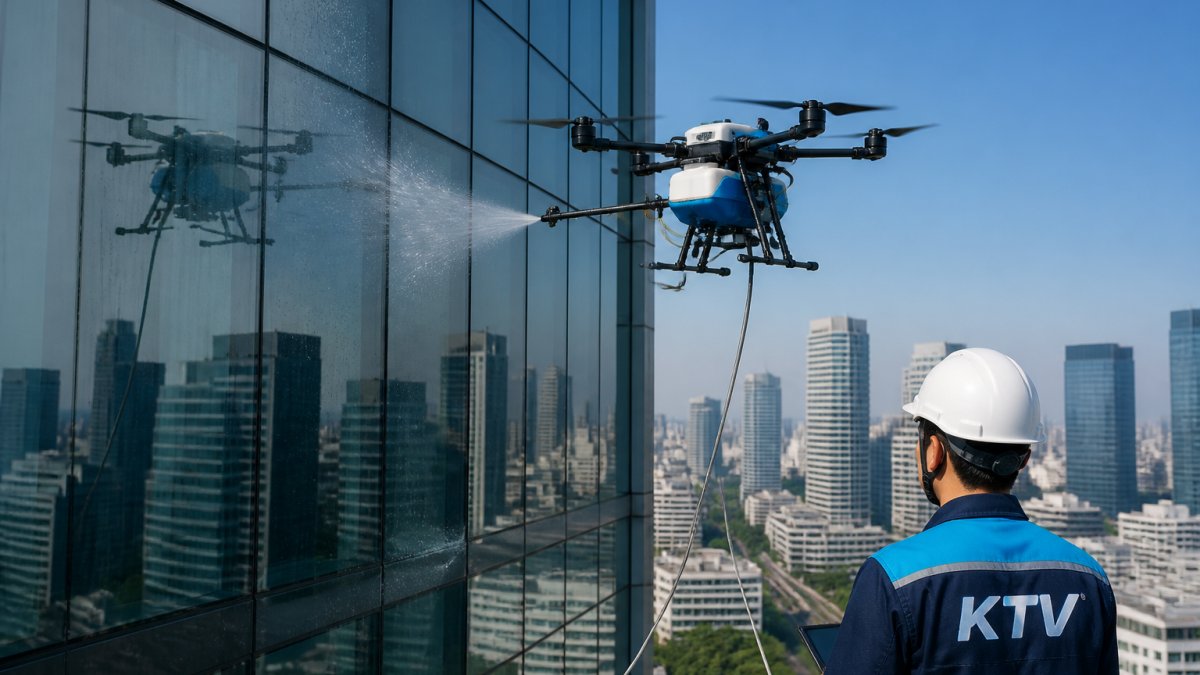
Most guides frame this as a technology upgrade. It's a risk transfer. Every hour a worker spends on rope access or a suspended platform is an hour of statutory exposure, insurance liability, and weather-dependent scheduling.
Manual facade cleaning on a tall building usually means rope access, scaffolding, or a building maintenance unit. Each carries a fixed cost floor that doesn't shrink with the size of the job.
That's the economic shift in one sentence: fixed, labour-heavy cost becomes variable, equipment-led cost.
Drone Facade Cleaning vs Traditional Methods: A Practical Comparison
Drone facade cleaning wins on speed and safety, but it isn't right for every surface.
Rope access requires anchor points, certified technicians, and a roof supervisor; setup alone can consume a meaningful share of the working day. Scaffolding takes longer and disrupts tenants.
Robotic systems split into two families. Semi-automatic cleaning keeps a human operator on the ground. Autonomous capabilities let the robot navigate the facade, adjust to surface contours, and complete a programmed route with minimal intervention.
What most comparisons miss is access coverage. No single method reaches every surface on a complex design.
Comparison Table: Cost, Safety, Speed, and Environmental Impact
| Method | Setup Time | Worker at Height | Relative Cost | Best For |
|---|---|---|---|---|
| Rope access | High | Yes | Highest labour share | Complex geometry, small areas |
| Scaffolding | Very high | Yes | High, plus tenant disruption | Major renovation work |
| Building maintenance unit | Low once installed | Sometimes | High capital cost | Buildings with fixed tracks |
| Semi-automatic robot | Low | No | Moderate | Regular cleaning cycles |
| Autonomous drone | Low | No | Moderate, scales with area | High-rise towers, large glass areas |
Pricing depends on building height, surface area, access complexity, and cleaning frequency. We don't publish fixed rates because a 20-storey and a 60-storey tower aren't comparable. For current pricing, request a quote directly.
How Facade Cleaning Safety Improves When Workers Leave the Rope
Facade cleaning safety improves the moment you remove the human from the height equation. Work at height is heavily regulated because falls remain a leading cause of serious workplace injury.
That shift is not cosmetic. Rope access needs certified technicians, rescue plans, anchor point verification, and a line supervisor. A robotic operation needs a trained operator, a pre-run check, and a documented maintenance log.
For insurance and compliance teams, the difference is measurable. Fewer people at height means fewer claim scenarios, and an auditable digital record of each cleaning run gives risk managers something concrete to show underwriters. Thailand's Department of Labour Protection and Welfare guidance on work at height sets out the employer's duty to control fall risks, and eliminating the exposure at source is the most direct form of control available.
The other safety gain is less obvious: surface damage. A worker on a suspended platform can't always control contact pressure.
Autonomous Capabilities and Wall-Climbing Mechanisms in Building Facade Cleaning Robots
Building facade cleaning robots attach to the wall via vacuum suction or magnetic adhesion. Glass and smooth cladding suit vacuum systems; ferrous surfaces suit magnetic ones. The mechanism determines where a robot can operate, which is why no single unit covers every building.
The wall-climbing mechanism is only half the story. Navigation separates a remote-controlled unit from a genuinely autonomous one.
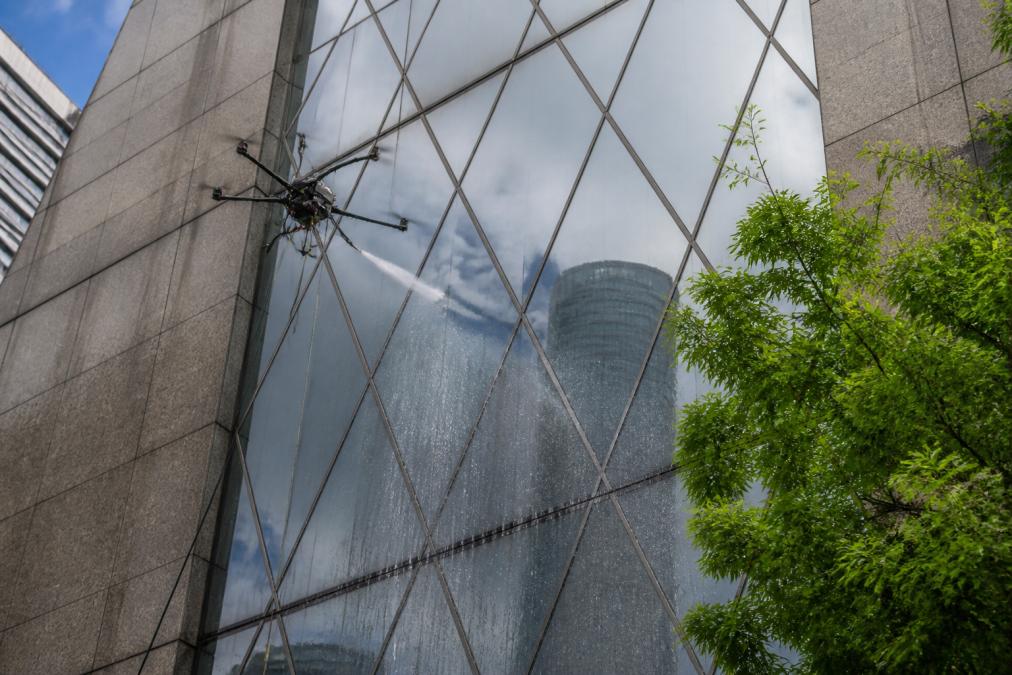
Glass-cleaning robots typically combine rotating brushes with a water feed and a squeegee or suction recovery stage: brushes lift surface contaminants, water carries them away, and recovery prevents streaking.
Robot adaptability is the practical limit. Buildings with deep recesses, protruding balconies, or irregular fenestration need a smaller unit or a hybrid approach: drones handle high, flat, accessible areas; robots handle vertical runs; rope access stays in reserve for the geometry nothing else reaches.
Sustainable Building Maintenance: Water, Chemicals, and Carbon Reductions
Sustainability claims in facade cleaning are easy to make and hard to check. The useful question isn't whether a method is "green", it's which inputs and outputs you can measure, and whether the numbers survive an auditor's scrutiny.
Four environmental levers to compare:
- Water consumption per square metre. Manual cleaning with a hose and squeegee typically uses far more water than a system with a controlled feed and recovery stage. Recovery systems capture runoff, filter it, and recirculate it, lowering net consumption. Ask for litres per square metre, not a vague efficiency claim.
- Cleaning agents and runoff. A chemical-free process that relies on water and mechanical action removes an entire category of reporting: no chemical storage, no disposal obligations, no runoff controls, and no exposure limits for the crew. Where chemicals are used, ask what they are, at what dilution, and how runoff is contained.
- Transport and setup emissions. Scaffolding must be trucked in, erected, and dismantled, and rope crews travel to site repeatedly across a multi-day job. A drone or robot operation arrives with the equipment and leaves, cutting the transport and setup emissions that often dominate a manual clean's footprint. This is where the largest carbon difference usually sits, not in the cleaning itself.
- Energy and equipment lifecycle. Battery-powered units draw from the grid for charging; brush motors and pumps consume power during the run. Ask for the energy source and whether the provider tracks it.
How to verify a claim. Self-reported figures carry little weight in a sustainability report. Auditors want a data trail:
- Per-run records with timestamps, coverage maps, and duration.
- Water use logged per run, not estimated per year.
- Method statement describing the process and any agents used.
- Equipment maintenance and calibration records.
- A stated methodology for any carbon figure, including the boundary.
If a provider quotes a percentage reduction in CO2, ask what it's measured against, over what boundary, and whether the underlying data is available. A number without a methodology is marketing.
Where this fits in reporting frameworks. Frameworks such as GRESB score buildings on measurable environmental performance, and independently verifiable data outweighs self-reported figures.
What Facility Managers Should Evaluate Before Choosing a Provider
Most guides hand you a checklist.
Start with a site survey, not a quote.
The five variables that actually drive cost and fit:
- Facade material and finish. Glass curtain wall, aluminium composite, painted concrete, and ceramic tile each behave differently under brush pressure and water. A method that suits one can dull or scratch another.
- Height and geometry. Flat vertical runs are the easy case. Deep recesses, louvres, and irregular fenestration usually force a hybrid approach, a primary method for the bulk of the surface and a secondary method for the remainder.
- Cleaning frequency. A quarterly cycle amortises equipment mobilisation differently from an annual deep clean. Higher frequency favours methods with low setup time per visit.
- Access constraints at ground level. Public footpaths, parking entries, and neighbouring structures affect how equipment is positioned and whether public-area controls are needed during the work.
- Reporting obligations. If your organisation reports to a sustainability framework or an insurer, the format of the cleaning record matters as much as the clean itself.
Total cost of ownership, not day rate. The contract price is only one line.
Regulatory and site-safety paperwork to request. In this market, work at height is governed by the employer's duty to control fall risks under the Department of Labour Protection and Welfare framework, and any operation involving aerial equipment or drones touches civil aviation rules. Ask the provider for:
- A method statement written for your specific building, not a generic template.
- Operator certification and training records for the equipment in use.
- Equipment inspection and maintenance schedule.
- Emergency and recovery procedure, including what happens if a unit loses adhesion or signal.
- Public liability and equipment insurance details in writing.
- A sample cleaning report showing coverage, timestamps, and any incidents.
Insurance and liability terms. Confirm who carries risk during the operation, the deductible, and how a damaged pane or panel is handled. Get it in writing, verbal assurances are not coverage.
Weather contingency. Drones and wall-climbing robots have wind and rain limits. Ask how partial jobs are billed, how the remaining area is rescheduled, and whether you pay for incomplete work.
| Evaluation Criterion | What to Ask | Red Flag |
|---|---|---|
| Site survey | Was the facade measured and mapped? | Quote issued without a survey |
| Access coverage | What % of facade is reachable, and what happens to the rest? | Claim of full coverage with no survey |
| Total cost | Breakdown across setup, consumables, insurance, residual work | Day rate quoted in isolation |
| Safety | Method statement, operator certification, inspection schedule | Verbal assurances only |
| Data | Sample per-run report with coverage and timestamps | No per-run records |
| Weather | How partial jobs are billed and rescheduled | Full charge for incomplete work |
| Liability | Insurance details in writing, deductible stated | Coverage not documented |
Conclusion: Matching the Right Cleaning Method to Your Building
The benefits of autonomous building facade cleaning are real, but conditional on fit. Simple geometry and large glass areas make the strongest case for a drone or robot system; complex fenestration may need a hybrid approach. The mistake is treating this as all-or-nothing.
What makes the switch work is the data trail. Safety documentation, coverage records, and verifiable environmental figures turn a maintenance line item into a compliance asset. KTV Working Drone Thailand provides fully autonomous drone technology, a chemical-free cleaning process, and independently verifiable ESG data with auditable digital records, backed by CAAT-certified operations.
Frequently Asked Questions
What are the benefits of autonomous building facade cleaning?
Autonomous facade cleaning removes work-at-height risks, cuts labor costs, and speeds up cleaning by up to 80% compared with rope access or scaffolding. It uses no chemicals, reduces CO2 emissions by as much as 96%, and produces auditable digital records for ESG reporting. For facility managers, the main gains are consistent cleaning quality, fewer site disruptions, and verifiable data that supports insurance and compliance reviews.
How does autonomous facade cleaning improve worker safety?
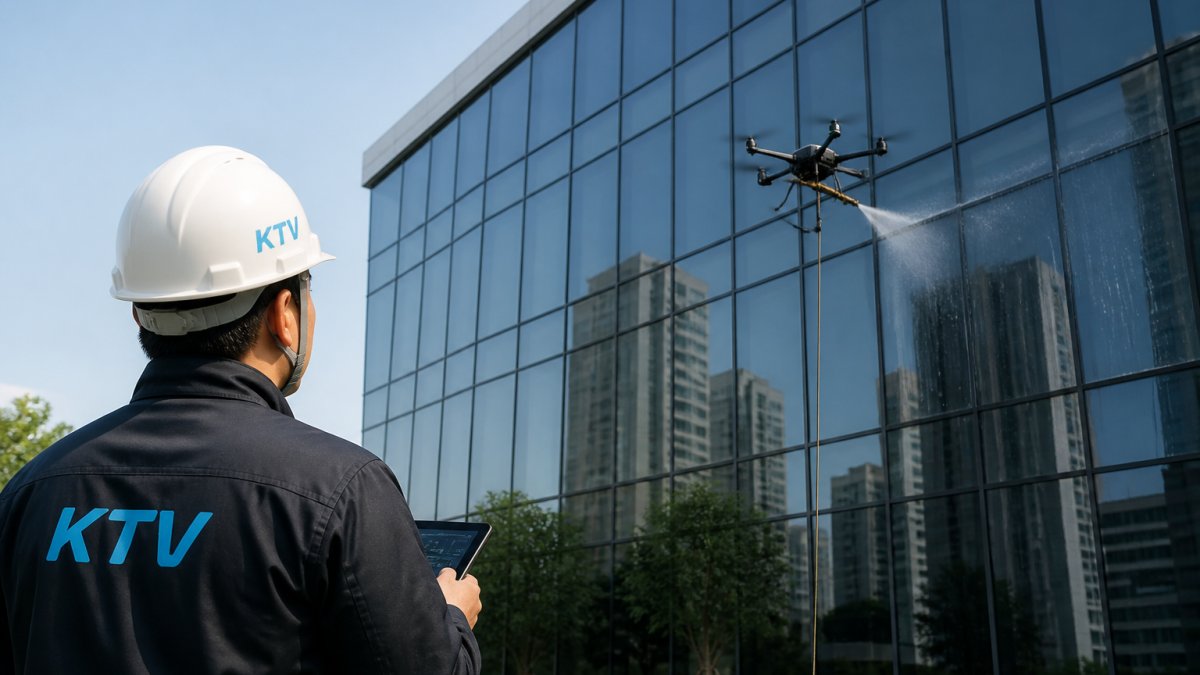
The biggest safety gain is eliminating rope access, scaffolding, and suspended platforms. Workers no longer hang off high-rise buildings or work near edges. Operators control the drone from the ground, away from fall hazards and restricted access zones. This reduces the risk of falls, equipment failure, and injuries from manual handling, which are the leading causes of serious incidents in facade maintenance.
Are cleaning drones faster than traditional facade-cleaning methods?
Yes. Autonomous drone cleaning can be up to 80% faster than rope access or scaffolding, based on KTV Working Drone Thailand's operational data. Setup time is minimal because there is no rigging or platform assembly. A typical high-rise facade that takes days with manual crews can often be completed in hours, depending on building height, surface area, and weather conditions.
Can robotic facade cleaning work on different building designs?
Most autonomous systems handle flat glass, curtain walls, and many textured surfaces. Wall-climbing robots with vacuum suction work well on smooth facades, while drones suit complex architectural designs, setbacks, and areas that are hard to reach with ropes or lifts. Before committing, ask the provider to assess your building's geometry, glass type, and any cracked or fragile panels.
Facade maintenance on a tall building shouldn't require putting anyone on a rope. If your current method depends on work at height, or if your ESG reporting needs independently verifiable data rather than self-reported estimates, we can help. Get a quote from KTV Working Drone Thailand and see how autonomous cleaning fits your building's access profile, safety requirements, and reporting obligations.