 how-to
Avoiding Facade Damage During Exterior Cleaning
Last Updated: October 23, 2026
Quick Summary
Avoiding facade damage during exterior cleaning requires matching the cleaning method to material type, testing chemicals on inconspicuous areas first, and maintaining proper pressure levels and contact times. High-pressure jets force water into cracks causing freeze-thaw damage, while incompatible chemicals etch stone, strip coatings, and drive salt deposits into porous substrates.
- Soft washing uses below 500 PSI with biodegradable agents and is safe for historic facades, painted surfaces, and delicate finishes.
- Pressure washing at 1500-3000 PSI works only on concrete, steel, and industrial surfaces; it damages masonry, historic materials, and finished surfaces.
- Always spot test cleaning agents on inconspicuous areas and wait 48-72 hours to reveal delayed reactions like efflorescence or etching.
- pH-neutral surfactants are safe across all facade materials after confirming sealer compatibility; acidic, alkaline, bleach, and solvent cleaners require material-specific assessment.
- Professional cleaning is recommended for materials above low-rise height, historic or coated surfaces, or when repair costs exceed several years of professional cleaning fees.
Table of Contents
- Why Avoiding Facade Damage During Exterior Cleaning Matters
- Understanding Building Facade Cleaning Methods
- How Pressure Washing Facade Damage Occurs
- Facade Cleaning Inspection Checklist Before You Start
- Chemical Compatibility and Material-Specific Safety
- Drone Facade Cleaning as a Damage-Prevention Solution
- DIY vs. Professional Risk Assessment
- Post-Cleaning Protective Treatments
- Frequently Asked Questions
Why Avoiding Facade Damage During Exterior Cleaning Matters
Facades endure constant stress from rain, pollution, UV exposure, and biological growth.
Facade repair is costly: water ingress can compromise entire building sections, and surface degradation reduces property valuation and tenant satisfaction.
Avoiding facade damage during exterior cleaning isn't optional for facility managers, it's the difference between maintaining your asset and destroying it.
Understanding Building Facade Cleaning Methods
Different surfaces demand different approaches; the wrong method causes streaking, erosion, chemical burns, and structural failure.
Soft Washing for Delicate Surfaces
Soft washing uses low-pressure water (below 500 PSI) with biodegradable cleaning agents, making it safe for historic facades, painted surfaces, and delicate finishes.
This method works best for:
- Historic or heritage-listed buildings
- Painted or coated surfaces
- Brick and mortar joints
It takes longer than pressure washing but prevents substrate damage: chemicals dissolve biological growth and dirt rather than blasting them away.
Pressure Washing: Risks and Safe Practices
Pressure washing uses high-velocity jets, typically 1500-3000 PSI, that remove dirt and algae quickly but damage vulnerable surfaces.
Safe pressure washing requires:
- Material assessment before starting
- Nozzle selection matched to surface hardness
- Distance maintenance (maintain an appropriate distance from the surface)
High-pressure methods work for concrete, steel, and industrial surfaces. They fail catastrophically on masonry, historic materials, and finished surfaces. One wrong decision costs thousands in repairs.
How Pressure Washing Facade Damage Occurs
Pressure washing damage happens in predictable ways. Understanding the mechanism helps you recognize risk before it becomes costly.
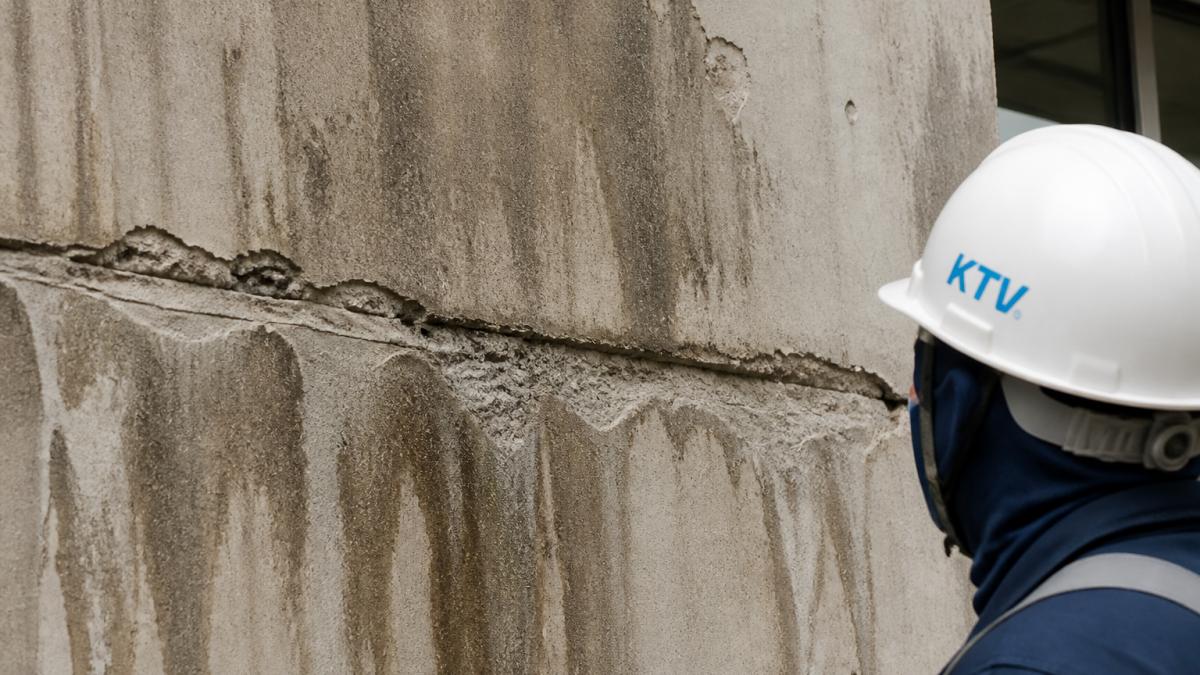
Pressure also erodes mortar directly: a 3000 PSI jet removes softer mortar faster than brick, creating gaps that channel water and accelerate deterioration.
Surface finishes get stripped away: paint, sealants, and protective coatings come off in minutes, leaving the substrate exposed to weathering and water ingress.
Facade Cleaning Inspection Checklist Before You Start
Every cleaning project needs a pre-work inspection to identify which method is actually safe.
Assessing Material Type and Condition
Start by identifying what you're cleaning. Different materials have different vulnerabilities.
Material identification checklist:
- Concrete, brick, or stone type (note any visible damage)
- Presence of mortar joints and their condition
- Painted, sealed, or bare surfaces
Document existing damage before cleaning starts. Photograph cracks, staining, and surface degradation. This protects you if damage claims arise later.
Test mortar joints by pressing with a screwdriver: soft, crumbling mortar cannot withstand pressure washing, while hard, intact mortar tolerates higher pressures.
Testing Cleaning Agents on Small Areas
Never apply a cleaning agent across the entire facade without testing first. Chemical compatibility varies by material type.
Spot-test procedure:
- Select an inconspicuous area (lower facade, hidden corner)
- Apply the cleaning agent at full strength
- Wait the recommended contact time
- Rinse thoroughly and allow to dry completely
- Inspect for discoloration, etching, or surface change
- Wait 48-72 hours and inspect again
This reveals delayed reactions: some chemicals etch stone slowly over days, while others cause efflorescence (white salt deposits) after drying.
Document results with photos, recording agent, concentration, contact time, and any changes observed.
Chemical Compatibility and Material-Specific Safety
Choosing the right cleaning agent matters as much as the right pressure level; wrong chemicals cause permanent surface damage that no amount of rinsing reverses. This section provides a material-by-agent compatibility framework you can apply on site.
Why pH Alone Is Not Enough
pH is a useful first filter but doesn't capture the full risk: two cleaners at the same pH can behave very differently because of solvent content, surfactants, chelating agents, and dwell time. A pH-neutral solvent gel can still soften a bituminous coating, and a mildly alkaline surfactant can still drive efflorescence in porous brick. Treat pH as a starting point, not a verdict.
Most mineral building materials tolerate a working solution in the pH 6-8 range for short contact times, but the safe window narrows sharply as porosity, age, and coating presence increase.
Material-by-Agent Compatibility Matrix
Use this as a screening tool, not a substitute for an on-site spot test. "Conditional" means the agent can be used only at controlled dilution, short dwell time, and after a successful spot test.
| Facade material | Acidic cleaners | Alkaline cleaners | Hypochlorite / bleach | Solvent-based degreasers | pH-neutral surfactant |
|---|---|---|---|---|---|
| Concrete (bare, sound) | Conditional, risk of surface etching on poor-cured or young concrete | Conditional, can leave residue on sealed concrete | Avoid, corrodes embedded reinforcement if it reaches steel | Conditional, can stain or leave oily residue | Safe |
| Clay brick (sound, unpainted) | Avoid, attacks mortar joints faster than brick units | Conditional, can drive efflorescence on porous brick | Avoid, degrades mortar and some pigments | Conditional, can soften some paints and sealers | Safe |
| Limestone | Avoid, dissolves calcium carbonate and etches the surface | Conditional, strong alkali can cause staining and salt movement | Avoid, reacts with stone and can leave salts | Avoid, can darken or stain porous stone | Safe |
| Marble | Avoid, acid etching is immediate and irreversible | Conditional, can dull polished finishes | Avoid, staining and surface reaction risk | Avoid, can penetrate and stain | Safe |
| Sandstone | Avoid, acid attacks the binder | Conditional, salt movement risk | Avoid, can mobilise salts and stain | Conditional, can leave residue in pores | Safe |
| Painted or coated surfaces | Conditional, depends on coating chemistry | Conditional, can soften some coatings | Avoid, can bleach pigments and degrade coating | Avoid unless coating manufacturer confirms compatibility | Safe after spot test |
| Anodised aluminium | Avoid, acid can attack the anodic layer | Conditional, strong alkali can dull or stain the finish | Avoid, can pit the surface | Conditional, check sealant compatibility | Safe |
| Glass (architectural) | Conditional, some acids etch or haze | Conditional, strong alkali can attack sealants and frames | Conditional, can stain frames and seals | Conditional, can leave films | Safe |
| Sealed or coated stone | Conditional, acid can attack the sealer | Conditional, alkali can break down some sealers | Avoid, can degrade sealer and leave salts | Avoid, solvents can dissolve the sealer itself | Safe after confirming sealer compatibility |
Dilution, Dwell Time, and Rinsing Discipline
Concentration and contact time cause most chemical damage, not the choice of agent alone:
- Dilute to the weakest effective concentration. Stronger is not better; it widens the damage window without reliably improving results.
- Keep dwell time short on porous and acid-sensitive materials. Long dwell times let the agent penetrate and react below the surface.
- Do not let cleaners dry on the facade. Drying concentrates the chemistry and drives salts into the substrate. Work in sections and rinse before the surface dries.
Reading the Failure Signs
Knowing what chemical damage looks like helps you stop before it spreads:
- Etching: dull, chalky, or whitened patches on stone or glass, usually acid attack.
- Efflorescence: white salt bloom appearing hours to days after cleaning, often alkaline or water-driven salt movement in porous masonry.
- Staining or darkening: discoloured patches on limestone or sandstone, often solvent or strong-alkali penetration.
If any of these appear during a spot test, stop and change the agent or method rather than adjusting concentration on the fly. Document the agent, dilution, dwell time, and result; that record makes the next job safer and faster.
Drone Facade Cleaning as a Damage-Prevention Solution
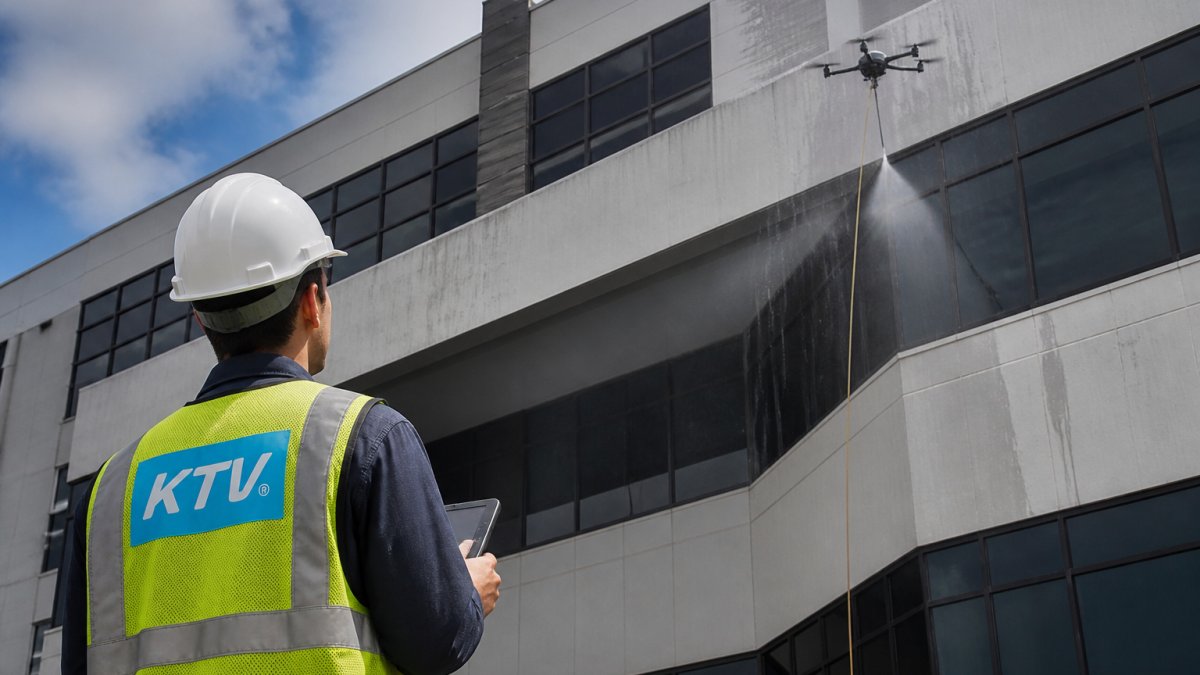
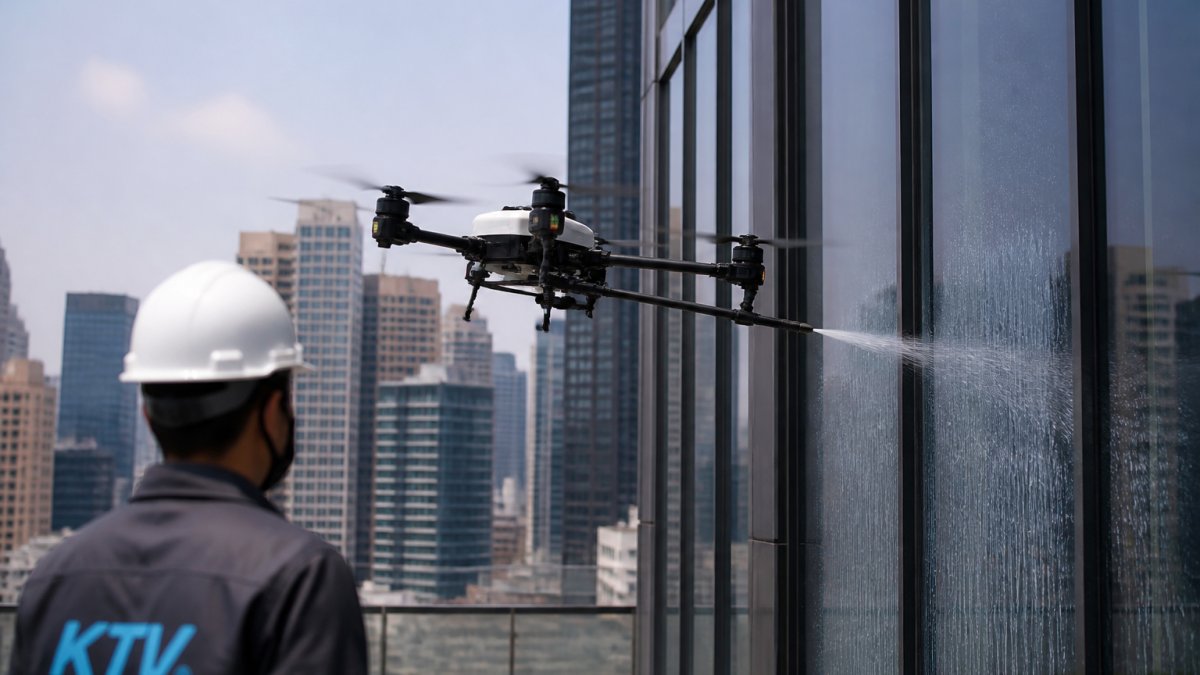
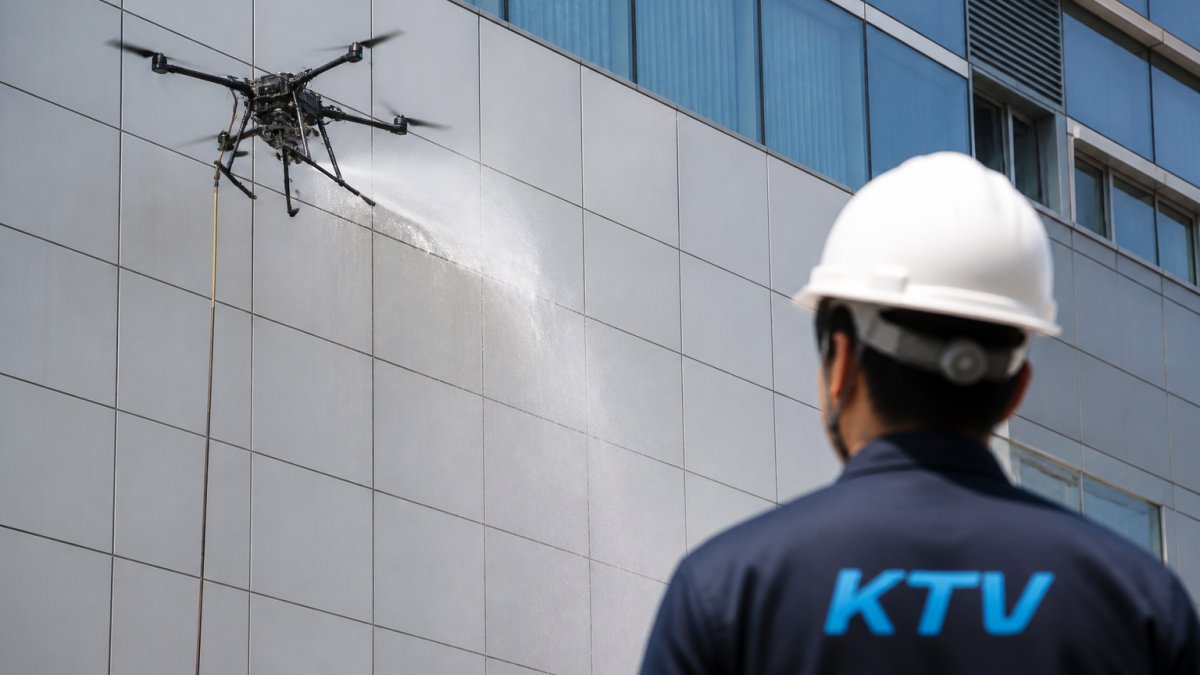
KTV Working Drone Thailand's fully autonomous drones deliver a chemical-free cleaning process that protects building facades.
This approach eliminates water ingress risk entirely. No high-pressure jets force water into cracks. No chemical residues remain to cause delayed damage.
For facility managers overseeing multiple properties, drone cleaning provides documented proof of proper maintenance: autonomous systems create auditable digital records of every cleaning cycle, supporting ESG reporting and regulatory compliance.
The method works on any facade type, historic, contemporary, delicate, or industrial.
DIY vs. Professional Risk Assessment
Deciding whether to handle facade cleaning internally or hire professionals is not a philosophical question; it is a risk-and-access calculation. The right answer depends on four variables: material fragility, building height and access, operator competence, and the financial consequence of getting it wrong. This section turns those variables into a usable decision framework.
The Four Variables That Decide It
1. Material fragility. Sound, modern, non-porous surfaces tolerate more handling than historic, porous, or coated surfaces.
2. Height and access. The method of access often decides the question before material does.
3. Operator competence. Pressure control, nozzle selection, chemical handling, and spot-test interpretation are skills.
4. Consequence of failure. If a mistake means repointing, recoating, or structural repair, the cost of failure dwarfs any cleaning saving.
A Practical Decision Matrix
Use this as a first-pass screen. If any row lands in the "professional" column, treat the whole job as professional unless a competent assessor confirms otherwise.
| Factor | Lean DIY | Lean professional |
|---|---|---|
| Material | Sound concrete, modern cladding, factory-finished panels | Limestone, sandstone, marble, historic brick, soft mortar, painted or coated surfaces of unknown history |
| Height / access | Ground level to low-rise, safe ladder or pole access | Above low-rise, or any work requiring scaffold, elevated platform, or rope access |
| Operator | Trained in-house operator with documented experience on the same material | No trained operator, or first time on this material type |
| Existing condition | No visible cracks, spalling, or crumbling mortar | Visible cracks, spalling, efflorescence, or soft mortar joints |
| Chemicals | pH-neutral surfactant only, after a successful spot test | Any acid, bleach, solvent, or strong alkali required |
| Consequence of failure | Cosmetic only, easily remedied | Repointing, recoating, structural repair, or heritage compliance risk |
| Insurance / liability | In-house work covered by existing policy | Work-at-height or chemical liability exceeds in-house cover |
What "Professional" Actually Buys You
Hiring a professional is not just labour. It buys four things that are hard to replicate in-house:
- Method selection competence. Experienced contractors match pressure, nozzle, chemical, and dwell time to the substrate, and know when to walk away from a method that is too aggressive.
- Access capability. Rope access, scaffold, and elevated platforms require trained operators, equipment inspection regimes, and safe systems of work. Doing this in-house without that infrastructure is where serious incidents happen.
- Liability cover. Professional providers typically carry public liability and contract works insurance that responds if damage occurs. In-house work usually falls back on the building's own policy, which may exclude cleaning-related damage.
The Cost-of-Failure Test
A simple way to settle borderline cases: estimate the cost to repair the worst plausible damage from getting the method wrong, then compare it with the quoted professional cleaning cost. If repair cost is a multiple of the cleaning cost, the professional option is the economically rational choice even before liability is considered.
When DIY Is Genuinely Reasonable
DIY is not always wrong. It can be appropriate when all of the following hold: the material is sound and non-porous, access is safe without specialist equipment, the operator is trained and has done the same material before, only pH-neutral chemistry is needed, and the consequence of a mistake is cosmetic and easily remedied.
Reducing Risk Either Way
Whichever route you choose, three controls reduce damage risk regardless of who holds the wand:
- Spot test first on an inconspicuous area and wait 48-72 hours before committing.
- Document before and after, photographs, methods, chemicals, and dilutions.
- Stop and reassess if the surface shows etching, efflorescence, staining, or coating breakdown during work.
For facility managers running multiple properties, the decision matrix is worth standardising into an internal checklist so the DIY-versus-professional call is made consistently rather than job by job.
Post-Cleaning Protective Treatments
Cleaning creates an opportunity to protect the facade for years ahead.
Protective treatments after cleaning:
- Penetrating sealers for porous materials (concrete, brick, stone)
- Hydrophobic coatings that repel water while allowing vapor transmission
- UV-protective finishes for painted surfaces
These treatments extend cleaning intervals and reduce future maintenance costs.
Application timing matters. Apply protective treatments within 48 hours of cleaning while the surface is clean and dry.
Document all treatments applied, including product names, application dates, and expected re-application intervals.
For facility managers managing multiple properties or buildings with delicate facades, KTV Working Drone Thailand eliminates these variables entirely. Contact KTV Working Drone Thailand for a quote and discover how autonomous cleaning extends your building's lifecycle while eliminating work-at-height risks.
Frequently Asked Questions
How do you clean a building facade without damaging it?
Start by identifying your facade material; concrete, brick, stone, or cladding each require different approaches. Use soft washing with pH-neutral cleaners for delicate surfaces, or pressure washing at low PSI (below 1500) for durable materials. Always test your chosen cleaning method on a small, inconspicuous area first. Avoid high-pressure jets on mortar joints, sealants, or aged surfaces. Consider professional services or autonomous drone cleaning for multi-storey buildings to eliminate substrate damage risk and ensure consistent results.
Can pressure washing damage a building facade?
Yes. High-pressure washing can erode mortar between bricks, crack stone, degrade painted finishes, and force water ingress into the building envelope. Pressure above 1500 PSI on masonry or 2000 PSI on concrete risks permanent finish degradation and structural decay. The risk increases on historic or aged facades where weathering has weakened the substrate. Always use the lowest effective pressure, maintain distance from the surface, and never direct jets at joints, seals, or compromised areas. Soft washing or professional cleaning services are safer alternatives.
What is included in a facade cleaning inspection checklist?
Assess material type, age, and existing damage before cleaning. Check for cracks, loose mortar, failing sealants, and areas of biological growth or surface discoloration. Test your chosen cleaning agent on a hidden spot and wait 24 hours to observe any adverse reactions. Inspect weather conditions, avoid cleaning in freezing temperatures or direct sunlight. Verify water drainage paths to prevent water ingress. Document the facade's condition with photographs. For multi-storey buildings, confirm access methods and safety protocols comply with work-at-height regulations.
Why should I consider drone facade cleaning over traditional methods?
Autonomous drone cleaning eliminates work-at-height risks associated with scaffolding and abseiling, reducing liability and safety incidents. Drones deliver consistent, controlled cleaning without the high-pressure jets that cause substrate damage or water ingress. The chemical-free process prevents finish degradation and protects building envelopes. Drones complete large facades up to 80% faster than manual methods, minimizing operational disruption. They provide auditable digital records and independently verifiable data, supporting ESG reporting and regulatory compliance for facility managers and asset owners.