 how-to
Eliminate Building Maintenance Liability: A 2026 Guide
Table of Contents
- Why Building Maintenance Liability Cannot Be Eliminated, Only Managed
- Building Maintenance Safety Procedures for Work-at-Height Tasks
- Preventive Maintenance Checklist for Buildings: A Quarterly Framework
- Building Maintenance Inspection Records and Audit-Ready Documentation
- Contractor Liability in Building Maintenance: Contracts, Insurance, and Defect Periods
- Incident Response and Evidence Preservation After a Maintenance Failure
- Conclusion: Building a Liability-Reduction Workflow That Holds Up
- Frequently Asked Questions
Last Updated: October 12, 2026
Why Building Maintenance Liability Cannot Be Eliminated, Only Managed
No building owner can fully erase maintenance liability. What you can do is reduce it, document it, and shift it where it belongs. That is the honest starting point, and it is where most guides on how to eliminate building maintenance liability quietly mislead you.
We work with facility and asset managers every week who assume a single method change removes their exposure. It does not.
That duty never disappears. It only moves.
So the real goal is control. You control liability when three things line up:
- Prevention through a written maintenance plan
- Evidence through inspection records and logs
- Allocation through contracts, insurance, and clear responsibility
Miss any one of these and gaps open. A hazard goes unreported. A repair gets deferred. A contractor's defect period lapses with no paper trail.
This guide walks through the seven-step workflow we recommend to reduce maintenance liability in practice, from safety procedures to incident response. None of it is glamorous. All of it holds up when something goes wrong.
Building Maintenance Safety Procedures for Work-at-Height Tasks
Work at height is where maintenance liability concentrates fastest. Falls, dropped tools, and facade damage are the events that trigger claims, and the safety procedures you write down are the first line of defence.

Start with hazard identification. Before any task, list every risk: height, weather, electrical lines, public access below, and equipment condition.
Then run a risk assessment for each one. Score it by how likely it is and how bad the outcome would be. High scores need controls before work starts, not after.
Your written procedures should cover:
- Fall protection and anchor points for any rope access
- Exclusion zones and signage below the work area
- Tool tethering to stop dropped objects
- Weather limits and stop-work triggers
- Rescue plans if someone is stranded at height
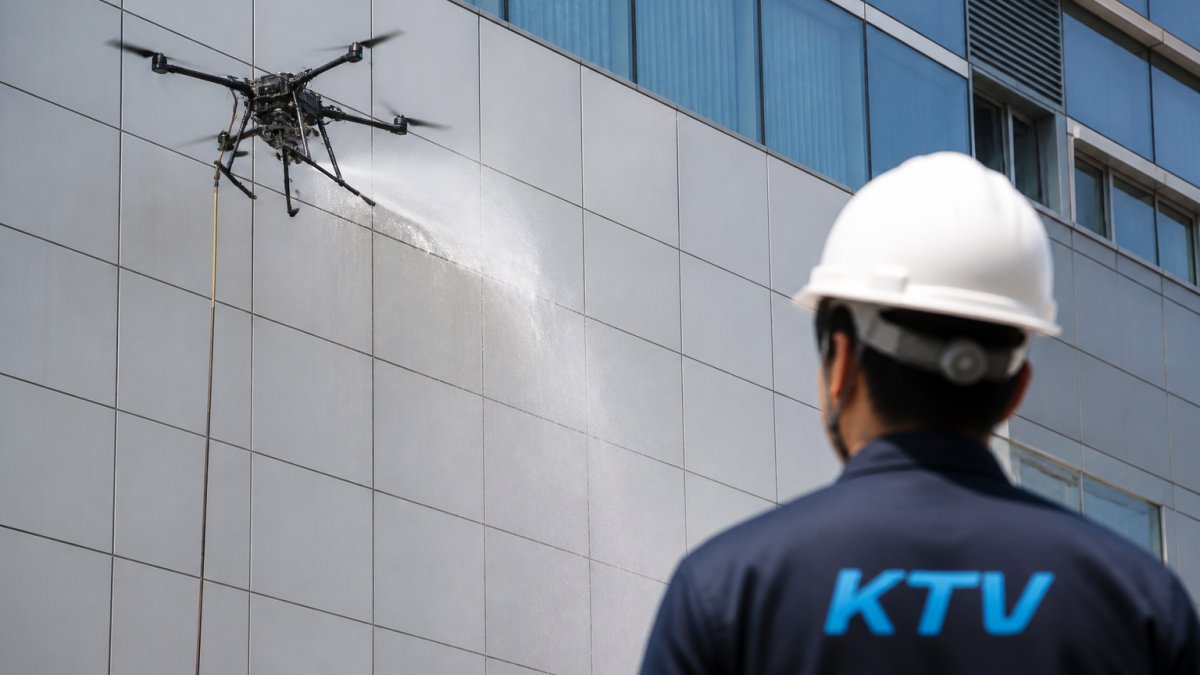
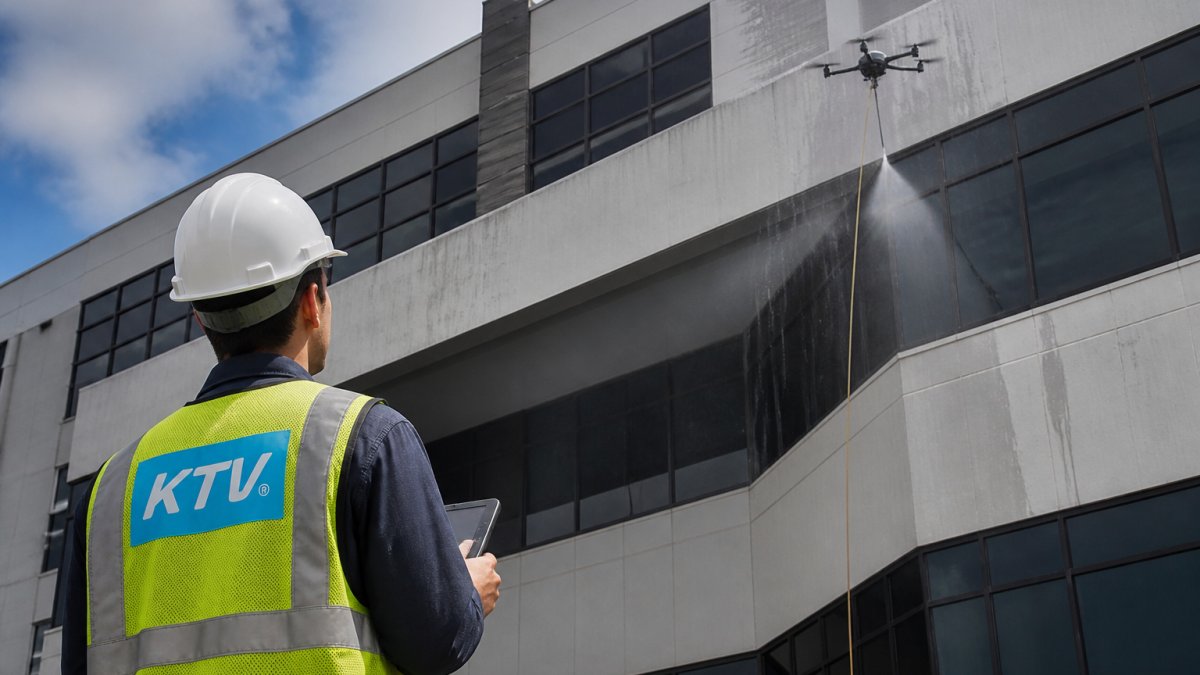
This is where method choice matters. Manual abseiling and scaffolding put people at height by design. Autonomous drone systems remove the worker from the hazard entirely, so the risk assessment for facade work changes shape. Fewer people at height means fewer fall exposures and fewer dropped-object incidents.
Preventive Maintenance Checklist for Buildings: A Quarterly Framework
A preventive maintenance checklist for buildings is only useful if it runs on a fixed cycle and ranks what it finds. Quarterly inspections catch defects while they are cheap to fix, before they become structural or safety problems. But a checklist that treats every item as equally urgent is just a to-do list, not a liability control.
Here is the framework we use. Adapt the items to your asset type.
| Frequency | Task | Owner | Record Produced |
|---|---|---|---|
| Monthly | Visual check of facade, roof, and drainage | Building manager | Inspection log |
| Quarterly | Full condition assessment and defect report | Property manager | Condition report |
| Quarterly | Safety equipment and access checks | Contractor | Compliance record |
| Annually | Reserve fund and budget review | Property owner | Maintenance budget |
| Annually | Insurance coverage review | Owner or manager | Policy update |
Rank Every Defect by Likelihood and Severity
The step most checklists skip is scoring. When a defect is logged, assign two ratings on a simple 1-5 scale: how likely is it to cause harm or damage, and how severe would the outcome be. Multiply the two for a risk score. A cracked facade panel above a pedestrian entrance might score 5 × 5 = 25. A hairline render crack on a rear wall might score 2 × 1 = 2. The scores tell you what to fix first, and they give you a written reason for every deferral decision.
Sort work into three bands:
- High risk (score 15-25): safety-critical, water ingress threatening structure, or anything affecting public access. Fix or isolate immediately.
- Medium risk (score 6-14): deteriorating but contained. Schedule within the current quarter.
- Low risk (score 1-5): cosmetic or slow-moving. Fold into the next planned cycle.
Track These Performance Indicators
A framework you cannot measure is a framework you cannot defend. Track at least these four numbers each quarter:
- Overdue high-risk work: count of high-band defects past their target date. This should be zero.
- Average response time: days from defect logged to work order issued, and from work order to completion.
- Repeat defects: items that reappear in the same location within 12 months. A rising count points to a root-cause failure, not a maintenance failure.
- Deferral rate: percentage of logged defects deliberately postponed, with the reason recorded.
Deferred Maintenance Tracking
When a repair slips, log it and log why, budget cycle, access restriction, awaiting parts, or awaiting owner approval. Unrecorded deferrals are the single biggest source of liability disputes, because nobody can prove the decision was reasonable. A dated deferral entry with a named approver turns a potential negligence claim into a documented management decision.
Building Maintenance Inspection Records and Audit-Ready Documentation
Audit-ready records are the difference between a defensible position and an expensive argument. If you cannot show what you inspected, when, and what you did about it, you carry the liability alone. The test is simple: could a third party who has never visited your building reconstruct your maintenance history from your files alone?
The Audit-Ready Records Checklist
Build your documentation set so each item answers a specific question an insurer, auditor, or regulator will ask.
- Inspection logs, date, inspector name and credential, location inspected, findings, and photographs. Answers: what did you look at, and when?
- Condition assessments, severity rating, risk score, and recommended action. Answers: how bad was it, and what did you decide?
- Work orders, assignment, authorization, scope, completion date, and sign-off. Answers: who did the work, and who approved it?
- Contractor credentials, licence, insurance certificate, and expiry dates held on file. Answers: was the contractor qualified and covered on the day they worked?
- Completion evidence, before-and-after photographs, test results, and handover notes. Answers: was the defect actually fixed?
- Compliance documentation, safety checks, statutory inspections, and certificates. Answers: were you meeting your legal duties?
- Follow-up records, re-inspection dates and confirmation that the repair held. Answers: did you verify the fix, or just assume it?
Who Owns Which Record
Gaps in accountability are where liability hides. Assign a single owner to each record type and write it into the responsibility matrix.
| Record | Owner | Verified By |
|---|---|---|
| Inspection log | Building or property manager | Owner (quarterly review) |
| Condition report | Property manager | Owner |
| Work order | Manager who issues it | Owner or manager (sign-off) |
| Contractor credentials | Manager who engages the contractor | Owner (annual audit) |
| Completion evidence | Contractor | Manager |
| Compliance certificates | Building manager | Owner |
Retention and Verification
Keep records for the life of the asset plus a defined tail, most practitioners retain maintenance records for at least the length of the longest defects liability period plus several years, because claims can surface long after a repair. Check the retention period your insurer and any applicable building or safety regulation require, and set the longer of the two as your floor.
Keep everything in one system. Scattered spreadsheets and paper folders fail under scrutiny because they cannot be searched, versioned, or timestamped reliably. Digital records help here. KTV Working Drone Thailand provides auditable digital records and independently verifiable ESG data, which matters when third parties review your maintenance history for reporting or insurance.
Contractor Liability in Building Maintenance: Contracts, Insurance, and Defect Periods
Contractor liability in building maintenance lives inside the construction contract. Get the terms right and risk moves to the party doing the work. Get them vague and it stays with you.
Four clauses do most of the work:
- Scope of work written precisely, so nothing is implied
- Defects liability period, the maintenance period after handover when the contractor must fix faults
- Insurance coverage with proof of current policy and adequate limits
- Indemnity and third-party risk terms covering damage to people and property
Check insurance before work starts, not after an incident. Ask for the certificate and confirm the policy is active.
Then think about accountability across everyone involved. A simple responsibility matrix stops the finger-pointing that follows a failure:
- Owner: sets the budget, approves the plan, holds the reserve fund
- Building or property manager: runs inspections, issues work orders, keeps records
- Tenant: reports defects and allows access
- Contractor: performs repair work to standard and holds insurance
Incident Response and Evidence Preservation After a Maintenance Failure
When a maintenance failure happens, the first hour decides how the claim unfolds. Preserve evidence before anyone cleans up, repairs, or moves anything.
Follow this sequence:
- Make the area safe and stop further damage
- Photograph and video everything from multiple angles
- Secure physical evidence, such as failed parts or debris
- Log the incident with time, location, and witnesses
- Notify insurers within the timeframe your policy requires
- Keep records together and do not alter them later
Incident reporting must be factual. Record what happened, not what you assume caused it. Opinions written in the first hour can be used against you months later.
If a claim follows, your insurance claim will lean on everything above. The insurer will ask for your inspection log, your maintenance schedule, and your contractor agreements. If those are complete, the claim is straightforward. If they are patchy, the premium and the payout both suffer.
Conclusion: Building a Liability-Reduction Workflow That Holds Up
Maintenance liability is a moving target, not a switch you flip. But a disciplined workflow moves it decisively in your favour.
Write the safety procedures. Run the quarterly checklist. Keep audit-ready records. Fix the contract terms. Preserve evidence when things fail. Do these five things consistently and your exposure drops with every cycle.
KTV Working Drone Thailand supports that workflow by removing people from work at height, delivering up to 80% faster exterior cleaning, cutting CO2 emissions by 96%, and producing the auditable digital records your insurers and auditors ask for. Get a quote.
Frequently Asked Questions
How can building owners reduce liability for maintenance work?
Owners reduce liability by documenting every decision: signed contracts with clear scope, inspection logs, work orders, and incident reports. Under Thai law, the Civil and Commercial Code holds owners to a duty of care, so courts look for evidence of reasonable maintenance. Preventive schedules, third-party condition assessments, and audit-ready records show you acted responsibly. Switching to methods that remove work-at-height risk, such as autonomous drone cleaning, also cuts the most common source of serious injury claims.
What is the 12-month defects liability period in construction?
In Thailand, construction contracts commonly include a defects liability period of 12 months after handover. During this window, the contractor must return and fix defects at no cost to the owner. This period does not remove the owner's ongoing duty of care: routine inspections and maintenance records still matter. After the defects liability period ends, the owner carries full responsibility for repair costs and any liability arising from neglect. Document all defect notices in writing.
How does preventive maintenance help reduce liability?
Preventive maintenance catches small defects before they become hazards. A quarterly inspection that logs cracked sealant, loose cladding, or blocked drainage creates a paper trail showing you identified and addressed risks. If an incident occurs, that record is your strongest defense. Preventive work also extends asset longevity, reduces deferred maintenance costs, and keeps insurance premiums lower. In practice, the documentation matters as much as the repair itself.
Who is responsible for building maintenance defects?
Responsibility depends on the contract and the defect's origin. Contractors are liable for workmanship and material defects during the defects liability period. Owners are responsible for wear and tear, tenant damage, and anything outside the contractor's scope. Building managers and property managers carry operational responsibility for routine inspections and hazard identification. A responsibility matrix signed by all parties prevents disputes. Under Thai law, unauthorized building work can also trigger regulatory penalties for the owner.