 how-to
How to Reduce Work at Height Risks: 7-Step Safety Guide
Table of Contents
- Start With a Working at Height Risk Assessment
- Apply the Hierarchy of Controls to Work at Height Hazards and Controls
- Choose the Right Fall Protection Equipment for the Task
- Run a Work at Height Safety Checklist Before Every Job
- Plan Rescue Before Anyone Climbs
- Train Workers, Supervise the Job, Coordinate Subcontractors
- Measure Whether Your Controls Are Actually Working
- Conclusion
- Frequently Asked Questions
Last Updated: October 18, 2026
Start With a Working at Height Risk Assessment
Before you touch a harness or book a scaffold, you need to know exactly what could go wrong.
At KTV Working Drone Thailand, we see the same pattern on commercial towers: the assessment gets treated as paperwork, then the real hazards show up on the roof.
A proper assessment answers three questions. What is the fall risk? Who could be hurt? What control makes that risk acceptable?
What the Assessment Must Record
Write down the task, the height, and the surface. Then record what protects the worker and what could fail.
- The exact task and how long it takes
- Height above ground and the drop zone below
- Surface type: concrete, metal roof, glass, fragile sheeting
- Weather exposure and wind limits
- Access route and anchor points
Keep it on file. If an inspector or insurer asks, a written record is your proof.
Who Carries It Out
A competent person does the assessment. In practice, that means someone with training, experience, and the authority to stop the job.
They must know the site, not just the rules. A rooftop with fragile skylights needs a different eye than a clean parapet.
Apply the Hierarchy of Controls to Work at Height Hazards and Controls
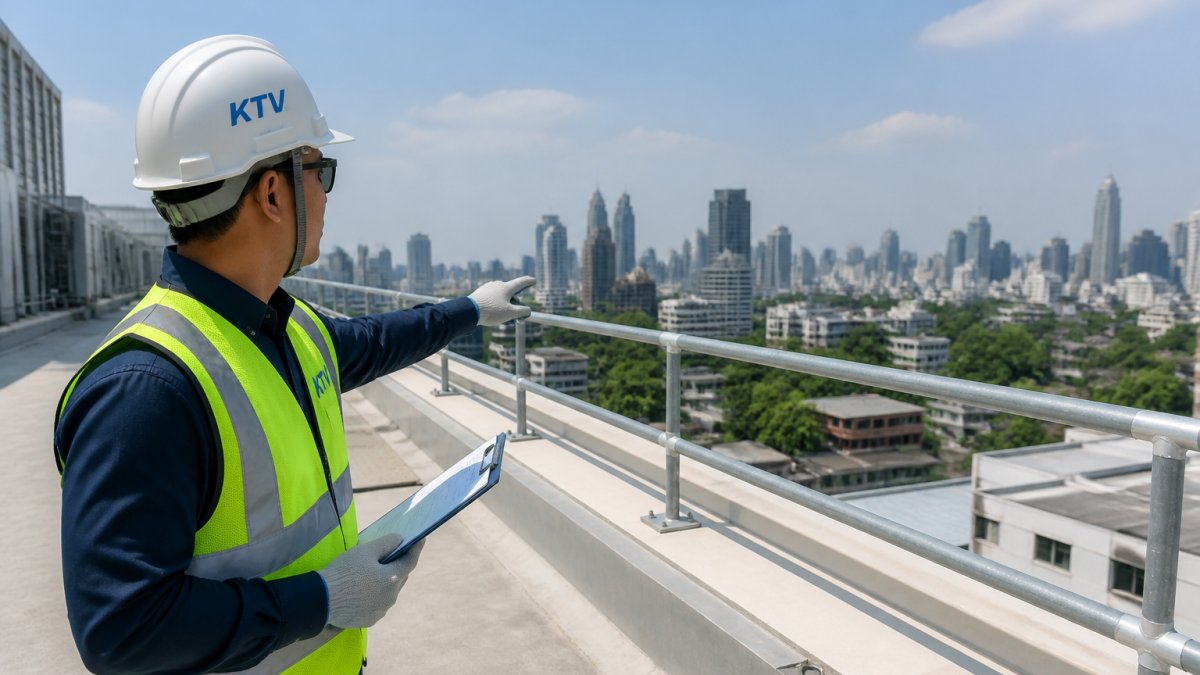
Here is where most guides get vague. They list controls without telling you which one to pick first. The hierarchy of controls fixes that.
Work through it in order. Stop at the first level that removes the risk.
| Level | Control | Example on a building |
|---|---|---|
| 1 | Eliminate the hazard | Clean the facade without sending anyone up |
| 2 | Collective protection | Guardrails, barriers, safety nets |
| 3 | Personal protection | Harness, lifelines, anchor points |
| 4 | Administrative | Training, permits, supervision |
Eliminate First: When the Job Does Not Need a Person Up There
Ask a blunt question: does a human need to be at height at all?
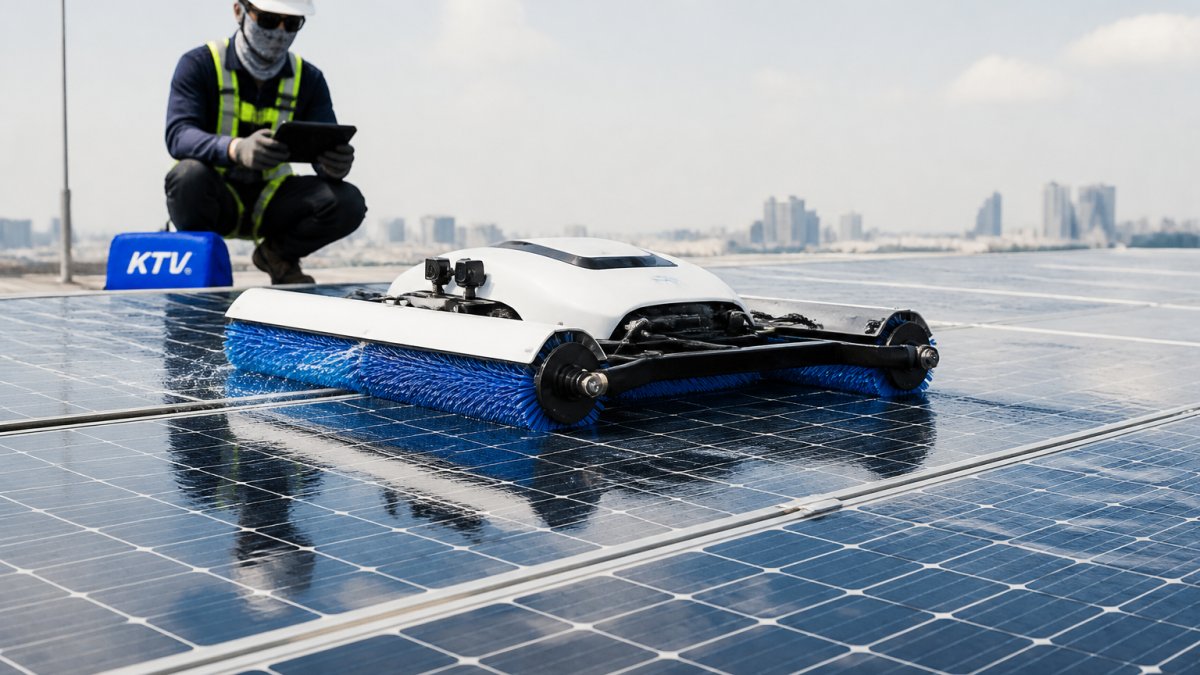
For facade cleaning, window washing, and solar panel upkeep, the answer is often no. Remote methods remove the fall risk entirely rather than managing it.
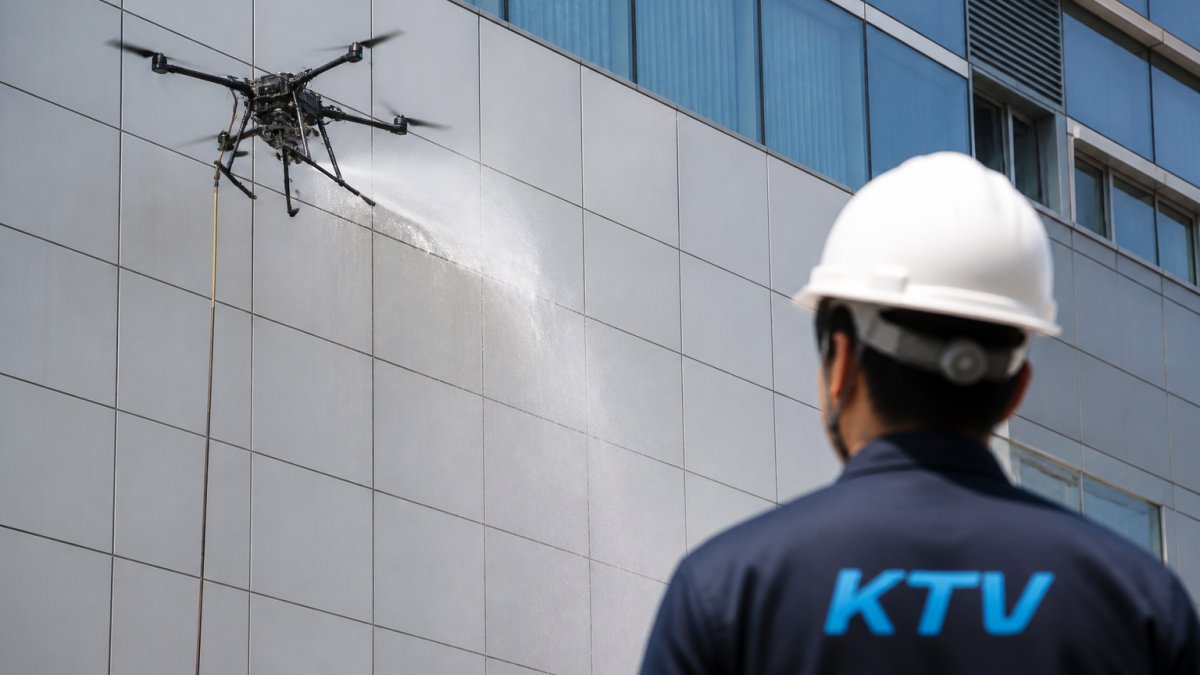
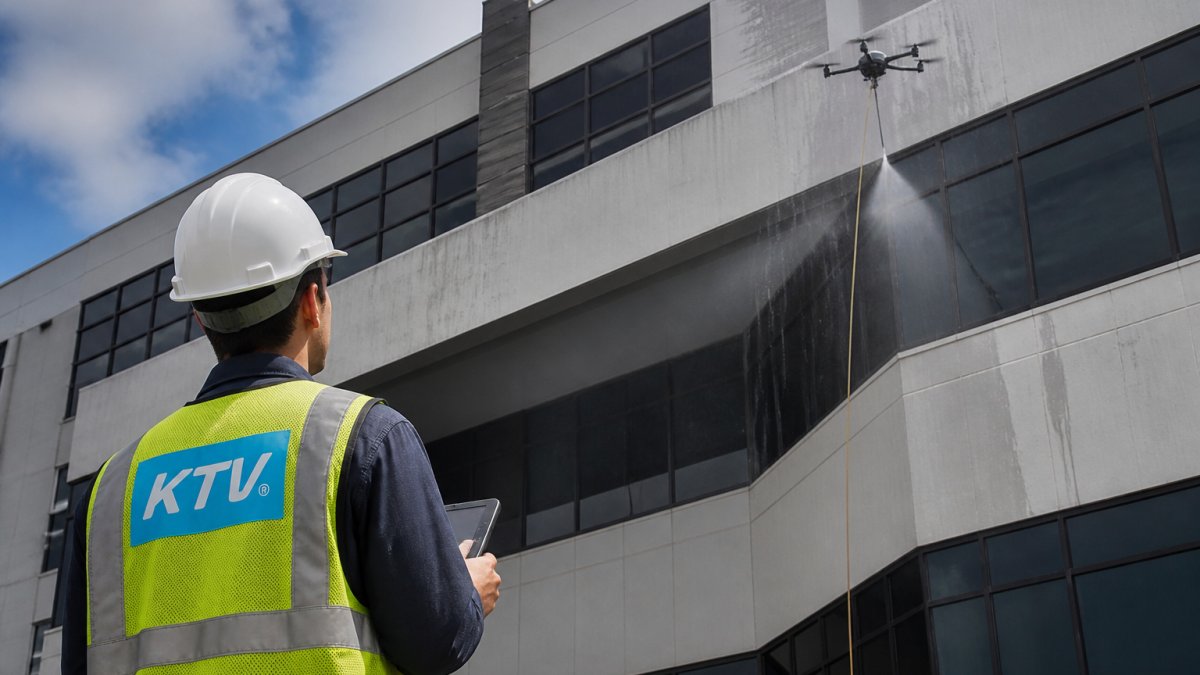
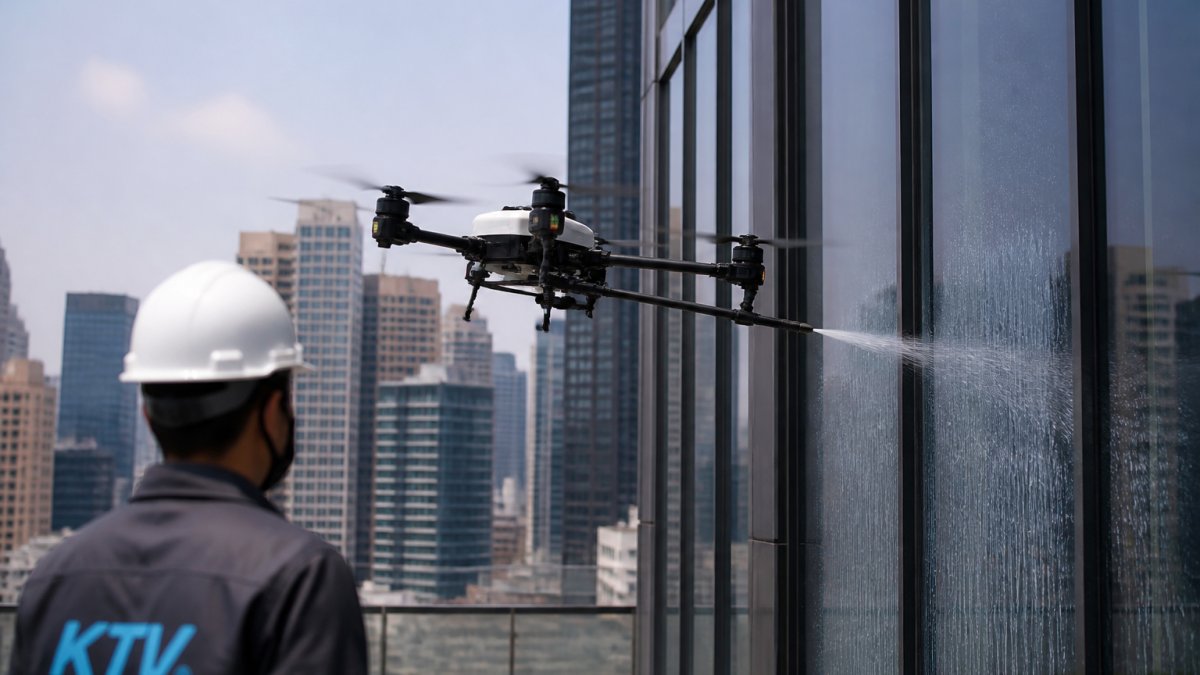
That is the principle behind our work at KTV Working Drone Thailand. Autonomous drones clean exterior surfaces with no scaffolding and no abseiling, so there is no one at height to fall.
Collective Protection Before Personal Protection
If someone must go up, protect everyone at once before you protect one person.
Guardrails, edge protection, toe boards, and safety nets are collective measures. They work without the worker doing anything. A harness only works if it is worn, clipped, and anchored correctly.
That difference matters. Collective protection does not depend on human memory at 8am on a windy morning.
Choose the Right Fall Protection Equipment for the Task
Fall protection equipment is the last line, not the first. Pick it only after elimination and collective measures have been ruled out. The mistake most guides make is listing kit without telling you which kit fits which job. Use the task and the site conditions to decide.
Match the Control to the Task
| Task or condition | First-choice control | Why it fits |
|---|---|---|
| Short-duration task near an open edge (under about 15 minutes) | Guardrail or temporary edge protection, set up before access | Collective protection works without the worker doing anything; a harness depends on correct clipping every time |
| Fragile roof or skylights | Crawling boards, staging, or platform with load-spreading; never rely on the sheet itself | Fragile surfaces fail without warning; spreading the load is the only reliable protection |
| Changing work area (moving along a facade) | Horizontal lifeline or rail system with rated anchors | A fixed anchor only protects one spot; a lifeline follows the worker |
| Restricted access or tight plant rooms | Tripod or davit with a winch for entry and rescue | Limited space rules out nets and guardrails; a winch also supports retrieval |
| Work above public areas | Safety nets plus exclusion zone below | Nets catch people and objects; the exclusion zone keeps the public out of the drop area |
| Tools and materials at height | Tool lanyards and tether points | Dropped objects injure people below even when the worker is secure |
Know What Each Item Actually Does
- Guardrails and barriers for open edges and roof perimeters, they stop the fall before it starts.
- Safety harness and fall-arrest system for work near an unprotected edge, they arrest a fall but leave the worker suspended, so rescue planning is mandatory.
- Lifelines and anchor points rated for the load and inspected before use, the anchor is only as good as its fixing.
- Safety nets to catch falls and falling objects, they need clearance below and correct rigging.
- Tool lanyards to stop dropped tools hitting people below.
- Exclusion zones to keep the public out of the drop area.
Pre-Use Inspection and Stop-Work Criteria
Check every item before each use. Look for frayed webbing, cracked hardware, corrosion, and expired tags. Stop work and remove the item from service if you find any of the following:
- Webbing with cuts, fraying, UV fading, or contamination from chemicals or paint
- Stitching that is pulled, broken, or loose
- Hardware with cracks, distortion, corrosion, or a gate that does not close and lock
- A shock absorber that has deployed or shows deployment indicators
- Missing or illegible inspection tags, or a tag past its inspection date
- An anchor point with unknown rating, visible movement, or corrosion at the fixing
Tag the item, quarantine it, and record the defect. Do not put it back in the van for someone else to find.
Run a Work at Height Safety Checklist Before Every Job
A work at height safety checklist turns good intentions into a repeatable habit. Run it before every job, not once a quarter. The difference between a useful checklist and a useless one is specificity: it must name what you are checking, who signs it off, and what happens when a box is unchecked.
Core Pre-Job Checklist
- Risk assessment completed, signed, and specific to this task and site
- Hierarchy of controls applied: elimination considered first, then collective protection, then personal protection
- Weather checked: wind, rain, heat, lightning, and forecast for the full shift
- Collective protection in place, secure, and load-tested where required
- Fall-arrest equipment inspected, tagged, and in date
- Anchor points rated, tested, and recorded
Task-Specific Add-Ons
Add these checks when the job matches the condition:
- Ladder work: ladder angle, footing, top securing, three points of contact, and a second person at the base for long durations.
- Scaffold work: tag in date, guardrails and toe boards fitted, safe access, and no unauthorised alterations.
- Fragile roof: crawling boards or staging in place, warning signage, and no reliance on the sheet for support.
- Roof edge work: parapet height checked, edge protection continuous, and openings covered and marked.
- Night or low-light work: lighting levels checked and visibility of edge markings confirmed.
Stop-Work Triggers
Agree in advance what stops the job. Common triggers include:
- Wind above the equipment or task limit, or sudden gusts
- Rain, ice, or lightning within the working area
- A damaged or out-of-date item found during inspection
- A missing or moved anchor point
- A change in task, access route, or site conditions not covered by the assessment
- A worker who is unwell, fatigued, or not trained for the task
If any box is unchecked or any trigger is met, the job does not start. That rule is the whole point of the checklist. Record the stop, the reason, and the corrective action so the next job benefits from it.
Plan Rescue Before Anyone Climbs
A fall-arrest system saves a worker from hitting the ground. It does not save them from hanging there.
Suspension trauma can set in fast (pubmed.ncbi.nlm.nih.gov). Someone left dangling needs to be reached and lowered quickly, and that takes planning done in advance.
Your rescue plan should cover:
- Who performs the rescue and how they are alerted
- Equipment for remote lowering or ground-level assembly
- How to reach an unconscious worker
- A clear emergency response route and contact
- A practice run, so nobody improvises on the day
Write it down and brief it before the first climb. A rescue plan nobody has read is not a rescue plan.
Train Workers, Supervise the Job, Coordinate Subcontractors
Training is not a one-off certificate. Competent workers need refresher training, and supervision has to be present on site, not just on the org chart.
Cover hazard identification, correct equipment use, inspection routines, and the authority to stop work.
Subcontractors are the weak link on many sites. Brief them on your procedures, check their equipment, and confirm their training before they start.
Measure Whether Your Controls Are Actually Working
Controls that look good on paper can fail quietly in practice. Track a few simple measures to find out.
- Near misses reported per month
- Inspection pass rates on equipment
- Checklist completion before jobs
- Training currency across the crew
- Time from hazard report to fix
Review these in a short monthly meeting. When a number slips, dig in before an incident forces the issue.
For facade and solar maintenance, the strongest measure is simpler: how many tasks still put a person at height? That is the direction we build toward at KTV Working Drone Thailand, with autonomous drone work and auditable digital records that stand up to ESG review.
Conclusion
Reducing work at height risks comes down to discipline: assess honestly, eliminate where you can, and protect collectively before you protect personally.
Where people still need to go up, plan the rescue, train the crew, and measure whether it is working.
For exterior cleaning and solar panel upkeep, the cleanest control is to remove the climb altogether.
Get a Quote and see how much of your at-height work can come off the roof.
Frequently Asked Questions
What are the main hazards of working at height?
The main hazards are falls from edges, openings and fragile surfaces, plus falling tools and materials that strike people below. Ladder movement, poor ground conditions and bad weather raise the risk further. On building facades, the hazard often comes from how the job is done rather than the height itself: abseiling, scaffolding erection and manual cleaning all put people on or above an edge. Identify each hazard in your work at height risk assessment and record the control that removes or reduces it.
How can drones reduce risks during exterior building maintenance?
Drones remove the person from height entirely, which is the strongest control in the hierarchy. For facade cleaning, autonomous drone systems keep workers on the ground, so there is no scaffolding to erect, no abseiling and no fall-arrest exposure. That also removes falling-object risk from tools and platforms. KTV Working Drone Thailand uses a chemical-free process and reports up to 80% faster cleaning with a 96% reduction in CO2 emissions, and it issues auditable digital records you can hand to auditors.
What should a work at height safety checklist cover?
A practical checklist covers the task and location, the access method, edge protection and barriers, anchor points and harness inspection, ground conditions, weather limits, exclusion zones below, tool lanyards, rescue arrangements and the names of trained people on site. Add a stop-work trigger list: wind above the stated limit, damaged equipment, missing guardrails or an unqualified operator. Sign and date it before each job, and keep the records for audit.
When should work at height be avoided altogether?
Avoid it when the task can be done from the ground, from a protected platform, or by remote equipment. Cleaning, inspection and survey work on facades, roofs and solar arrays are common examples where a drone or ground-level method replaces a person on an edge. If the task still needs someone up high, use collective protection such as guardrails and work platforms before relying on a harness. Record the reason in your risk assessment.