 blog
blog
Automated Solar Panel Maintenance for Farms: 2026 Guide
Table of Contents
- Why Solar Panel Maintenance for Farms Is a Different Challenge
- How Automated Solar Panel Cleaning Efficiency Changes the Math
- Drone-Based Solar Panel Inspection: Finding Problems Before They Cost You
- ROI and Payback Period: What Farm Owners Should Actually Calculate
- Integrating Automated Maintenance with Agrivoltaics and Farm Operations
- Maintaining the Cleaning System Itself: What Nobody Tells You
- Safety, Compliance, and Insurance: What Thai Farm Operators Need to Know
- Conclusion: Building a Smart Maintenance Plan for Your Farm
- Frequently Asked Questions
Last Updated: September 29, 2026
Why Solar Panel Maintenance for Farms Is a Different Challenge
Farm solar sites get dirty faster than almost any other installation. Automated solar panel maintenance for farms exists because manual cleaning cannot keep up with agricultural dust, pollen, and bird activity.
Dust, Pollen, and Bird Droppings: The Soiling Loss Reality
Not all dirt blocks light the same way. Loose dust scatters sunlight, but bird droppings can shade a cell completely, and one shaded cell can drag down a whole string of modules.
Farm-specific soiling sources include:
- Dust from tilling, harvest, and unpaved access roads
- Pollen from orchards, rice, and field crops
- Bird droppings near trees, ponds, and livestock sheds
- Ash and residue from field burning in the dry season
How Automated Solar Panel Cleaning Efficiency Changes the Math
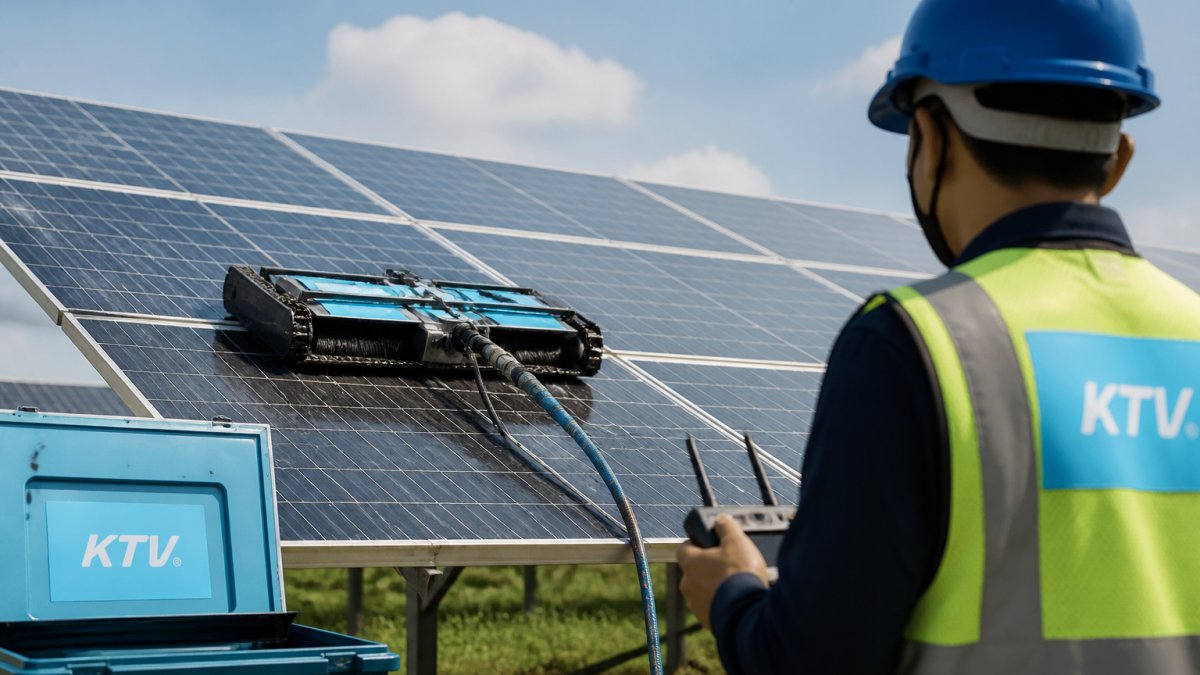
Automated cleaning wins on consistency, not just speed: a robot or drone cleans on schedule, soiling never reaches the level where losses spike, and nobody climbs onto a roof or array frame.
Automated solar panel cleaning efficiency comes from three things:
- Frequency: cleaning before soiling loss peaks, not after
- Coverage: every module cleaned the same way, every time
- No downtime: work happens without stopping farm operations
Waterless Cleaning and Mechanical Brushes Compared
Waterless cleaning uses soft brushes, microfiber, or air to lift dust without water. Mechanical brush systems use rotating brushes, sometimes with a little water, to scrub the glass. On a farm, the differences that matter are brush pressure, water volume, cycle time, and how each handles a sticky film.
| Method | Water Use | Typical Cycle | Best For | Main Drawback |
|---|---|---|---|---|
| Waterless brush (dry) | None | Slow, multiple passes | Dry, dusty sites with water limits | Needs regular passes; struggles with pollen film |
| Mechanical brush with water | Low | Moderate | Sticky soiling, pollen film, bird droppings | Water access and runoff management required |
| Drone-based cleaning | None to low | Fast over large areas | Tall, awkward, or spread-out arrays | Wind limits operating days |
| Semi-autonomous rail or gantry | Low | Fast on fixed rows | Single-orientation ground arrays | High install cost; not portable between sites |
Matching the Method to Your Soiling Profile
The right pick depends on your soiling type and water supply. A few rules of thumb:
- Pure dust, dry season, no water access: waterless brush or drone, run on a short cycle so dust never builds a film.
- Pollen or sticky residue: some moisture is usually needed, because dry brushing can smear the film rather than remove it.
- Bird droppings near trees, ponds, or sheds: spot treatment first, then a full pass, droppings shade cells and are the highest-value target per square metre.
- Mixed crop and livestock sites: expect two soiling peaks per year, one at harvest and one at peak pollen, and schedule around both.
Drone-Based Solar Panel Inspection: Finding Problems Before They Cost You
Drone-based solar panel inspection finds faults the eye cannot see from the ground, with thermal cameras spotting hot spots, cracked cells, and failing connections while the array runs.
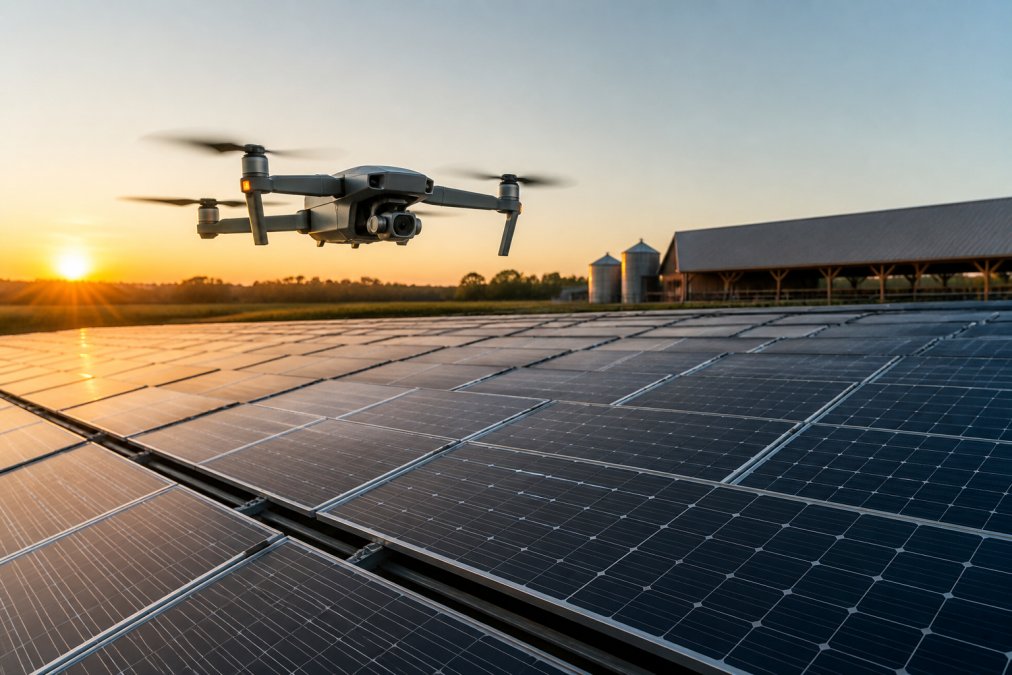
A practical inspection routine looks like this:
- Fly a thermal scan across the whole array
- Flag any module running hotter than its neighbors
- Cross-check flagged modules against soiling patterns
- Clean, then re-scan to confirm the fault was dirt, not damage
- Log everything with a date and location
ROI and Payback Period: What Farm Owners Should Actually Calculate
Most farm owners look at the cleaning cost and stop there. That is the wrong number. What matters is the value of the energy you recover, and the only way to compare the two is on the same annual basis.
To work out payback, you need four figures:
- Your array's rated capacity, in kilowatts
- Your current soiling loss, as a share of output
- Your energy price or feed-in rate, in baht per kilowatt-hour
- Your annual cleaning cost, including the system, its upkeep, and any water
The Payback Formula, Step by Step
The logic is simple: if cleaning recovers more energy value than it costs, it pays. If not, you clean less often or not at all.
- Estimate annual generation. Take your array's rated capacity, multiply by your local peak-sun hours per day, then by 365. A 100 kW array in a typical farming region with about 4.5 peak-sun hours per day generates roughly 164,000 kWh a year before losses.
- Apply your soiling loss. If your measured soiling loss is 4%, you are losing about 6,560 kWh a year. If it is 12%, you are losing about 19,700 kWh.
- Value the recovered energy. Multiply the recovered kilowatt-hours by your rate. If you sell at a feed-in rate, use that. If you self-consume and offset a retail tariff, use the retail rate, it is usually higher, which shortens payback.
- Subtract the annual cleaning cost. Include the system's own maintenance, not just the cleaning passes.
- Divide the net annual benefit into the upfront cost. That gives you payback in years.
Why Soiling Loss Is Not Linear
What most guides miss is that soiling loss does not climb in a straight line. A lightly soiled array loses little. A heavily soiled array can lose a large share of output, and the last stretch of soiling is where the money is. Cleaning before you reach that point is where the return sits.
The Costs Most Payback Calculations Leave Out
A payback figure is only as good as the costs you put in. Four items are commonly forgotten:
- Water and runoff management, if your method uses water and your site needs containment.
- Cleaning-system maintenance, covered in its own section below, brushes, batteries, sensors, and firmware are recurring costs, not one-offs.
- Downtime during cleaning, if the array has to be isolated. Drone and above-panel systems usually avoid this; rail systems on fixed rows may not.
- Insurance and certification, if your provider passes those costs through.
Integrating Automated Maintenance with Agrivoltaics and Farm Operations
Agrivoltaics means growing crops or grazing livestock under and between solar panels. It is growing fast on farms that want two incomes from one piece of land.
Automated systems handle this better than manual crews for a few reasons:
- Robots and drones work above the crop, so they do not trample plants
- Cleaning can be scheduled around harvest and irrigation cycles
- Remote management means one operator can cover several sites
Maintaining the Cleaning System Itself: What Nobody Tells You
Nobody sells you a cleaning system and tells you it needs its own maintenance. It does.
A simple upkeep schedule:
- Weekly: visual check of brushes, nozzles, and props
- Monthly: clean sensors and check battery health
- Quarterly: replace worn brushes and recalibrate
- Annually: full service and software update
Safety, Compliance, and Insurance: What Thai Farm Operators Need to Know
Drone operations in Thailand fall under the Civil Aviation Authority of Thailand, which sets the rules for commercial flights, registration, and operator certification. Farm operators hiring a drone service should confirm the provider holds the right certification first.
Civil Aviation Authority of Thailand drone regulations
Insurance is the piece farm owners ask about most. Before any cleaning job, confirm:
- The provider carries liability cover for damage to panels
- The policy covers drone malfunction, not just operator error
- You have written proof of cover, not a verbal promise
Thai General Insurance Association
Conclusion: Building a Smart Maintenance Plan for Your Farm
The hard part is not choosing a cleaning method but building a schedule you can actually keep, across seasons, crops, and weather.
Frequently Asked Questions
How does automated cleaning improve solar panel efficiency?
Dust accumulation on photovoltaic modules blocks sunlight and reduces energy output. In dusty agricultural environments, soiling loss can cut generation by several percentage points between cleanings. Automated systems, including robotic and drone-based cleaning, remove dust on a scheduled basis so panels stay closer to peak performance. Because the cleaning is consistent and data-driven, farm managers can track energy yield improvements and adjust cleaning frequency based on actual soiling rates rather than guesswork.
Is waterless cleaning effective for solar farms in dusty environments?
Waterless cleaning uses soft mechanical brushes or microfibre systems to lift dust without water. In areas where water is scarce or expensive, this approach avoids the cost and logistics of transporting water to remote arrays. It also eliminates the risk of mineral deposits left behind by hard water. For farms dealing with fine dust or pollen, waterless methods work well when paired with a regular schedule and sensor-based monitoring that triggers cleaning before soiling loss becomes significant.
What are the long-term cost savings of automated solar maintenance?
Automated maintenance reduces operational expenditure in several ways: lower labour costs, fewer manual inspections, less water consumption, and reduced module degradation from improper cleaning. Preventative maintenance also catches cracked panels, hot spots, and wiring issues early, avoiding expensive replacements. A cost-benefit analysis should factor in energy yield recovery, extended asset life, and the avoided cost of work-at-height safety measures. Pricing for specific systems depends on array size and site conditions, so request a quote for accurate figures.
How do autonomous systems handle large-scale solar arrays?
Autonomous robotic systems and drones are designed for large-scale solar plants. They follow pre-programmed routes, use sensor-based navigation to avoid obstacles, and can operate across hundreds of rai without direct human control. Remote management platforms let operators schedule cleaning, monitor performance, and receive alerts when soiling thresholds are exceeded. This makes automated scheduling practical for utility-scale farms where manual cleaning would take weeks and put workers at risk.