 how-to
Professional Facade Maintenance for Malls: 2026 Guide
Table of Contents
- Why Professional Facade Maintenance for Malls Cannot Wait
- The Facade Inspection Checklist Every Mall Needs
- Building a Facade Maintenance Safety Plan
- How Drone Facade Cleaning Changes the Job
- Setting a Preventive Facade Maintenance Schedule
- Choosing a Facade Maintenance Provider: Questions That Separate Them
- Budgeting and Measuring Professional Facade Maintenance for Malls
- Frequently Asked Questions
Last Updated: October 17, 2026
Why Professional Facade Maintenance for Malls Cannot Wait
Facade maintenance is the planned cleaning, inspection and repair of a building's exterior surfaces to protect structural integrity, appearance and public safety.
The stakes are easy to underestimate. A mall facade takes constant punishment: monsoon rain, heat cycling, traffic film and pollution.
Below, we'll show you exactly how to build a maintenance programme that holds up to audit, keeps shoppers safe and controls cost over the life of the asset.
The Facade Inspection Checklist Every Mall Needs
A facade inspection checklist is a structured record of what gets checked, how often, by whom and what triggers a repair. Without one, maintenance becomes reactive and disputes with contractors become your word against theirs. Most generic guides stop at "inspect regularly", a mall needs a checklist that is specific to its materials, its height zones and its trading pattern.
Set inspection intervals by risk, not by habit
A common pattern among mall operators is to run three inspection tiers, with frequency set by facade zone risk rather than a single calendar:
- Walk-by visual check (monthly): ground-level review of staining, efflorescence, cracked sealant, damaged cladding, blocked drainage and loose fixings. Highest-frequency, lowest-cost tier.
- Close inspection (quarterly): glass and curtain wall panels, expansion joints, sealant lines, anchor points, signage fixings and rooftop equipment, accessed by drone, rope or MEWP depending on zone.
- Detailed condition assessment (annually): a written report scoring each facade zone, with photographs and a prioritised defect list.
Zones exposed to monsoon-driven rain, heavy footfall below, or recent repair history should move up a tier, for example, a curtain wall above a main entrance may warrant close inspection every two months rather than quarterly. Zones with low public exposure and stable condition can stay on the base schedule.
Material-by-material checklist
Use this as the working checklist for close inspections. Each line should be recorded as pass, monitor or defect, with a photo and a location reference.
| Material / element | What to check | Typical defect |
|---|---|---|
| Glass and curtain wall | Cracks, chips, sealant adhesion, gasket compression, panel alignment | Failed sealant, water ingress, loose gasket |
| Aluminium composite panels | Fixing tightness, surface coating, joint alignment, denting | Loose panel, coating chalk, water tracking |
| Precast concrete | Cracking, spalling, exposed reinforcement, efflorescence | Carbonation, chloride attack, section loss |
| Sealant and expansion joints | Adhesion, cohesion, cracking, compression set | Debonding, water path into envelope |
| Stone and tile cladding | Fixing integrity, staining, joint erosion, hollow spots | Panel detachment risk, biological growth |
| Painted and coated surfaces | Blistering, peeling, chalking, colour fade | Coating breakdown, substrate exposure |
| Drainage and gutters | Blockage, overflow staining, fixing condition | Water backup, overflow onto facade |
| Signage and fixings | Anchor tightness, corrosion, electrical integrity | Falling object risk, water ingress at penetration |
| Rooftop and parapet | Flashing, coping, membrane termination | Water entry at roof-to-facade junction |
Grade every defect so repairs get prioritised
A checklist without severity grading produces a list nobody acts on. Grade each finding:
- Priority 1 (immediate): any risk of falling material, exposed live electrical component, or active water ingress into the envelope. Isolate the area and repair before the next trading day.
- Priority 2 (within 30 days): sealant failure, cracked panel without detachment risk, blocked drainage ahead of rain.
- Priority 3 (next planned cycle): cosmetic staining, coating fade, minor joint erosion.
Record every finding with a location, a date, a severity grade and a photo. That file becomes your evidence trail for insurers, auditors and future contractors, and it lets you compare defect closure rates between providers.
Building a Facade Maintenance Safety Plan
A facade maintenance safety plan sets out how work at height will be controlled, who authorises it, and how the public is protected while it happens. In a mall, the public is the hard part: shoppers, delivery vehicles and tenants all share the space beneath the work, and the building cannot simply close. The plan therefore has to be an operational document, not a compliance binder.
Control the work zone, not just the work
For every facade zone, define the exclusion zone by the drop path, not by a fixed radius. A panel or tool released at height does not fall straight down, wind drift and bounce mean the ground-level exclusion must extend beyond the vertical footprint. Practical controls:
- Physical barriers at ground level, with signage in the languages your shoppers read.
- Overhead protection where the work is above an entrance or walkway that must stay open.
- Dedicated spotters at ground level for the duration of any work above occupied space.
- Tool tethering and dropped-object controls written into the method statement, not assumed.
Keep the mall trading while work proceeds
The operational plan should answer four questions for every work window:
- Which entrances and accessible routes stay open? Never close the only accessible route to a tenancy. Coordinate with tenant fit-out and delivery schedules so work does not collide with peak trading or loading bay activity.
- When is the work window? Schedule noisy or disruptive work outside trading hours where possible. Where work must happen during trading, agree the window with affected tenants in advance and confirm it in writing.
- How are shoppers and tenants notified? Use entrance signage, centre management announcements and tenant briefings with times, entrances affected and diversions. Give tenants at least 48 hours' notice of any work visible from their shopfront.
- What stops the work? Define weather limits (wind speed, lightning, rain) and a stop-work authority that any supervisor can exercise without escalation.
Permits, competency and records
- Permit-to-work and sign-off before any work at height begins, with the access method, exclusion zone and emergency plan attached.
- Access method risk assessment for each facade zone, covering the equipment, the ground conditions and the public interface.
- Competency records for everyone involved, operators, spotters and supervisors, kept on file and available to the mall's safety officer.
- Emergency procedures for equipment failure, falling objects, weather stops and medical incidents, rehearsed with centre management rather than written once and filed.
Working at height remains one of the most serious risks in building upkeep, and the International Labour Organization's guidance on safety and health in construction is a useful reference for structuring controls. Map those controls to your own permit-to-work system and to the requirements your insurer and local regulator expect to see.
How Drone Facade Cleaning Changes the Job
Drone facade cleaning replaces rope access and scaffolding with an unmanned aircraft that washes exterior surfaces from the air.
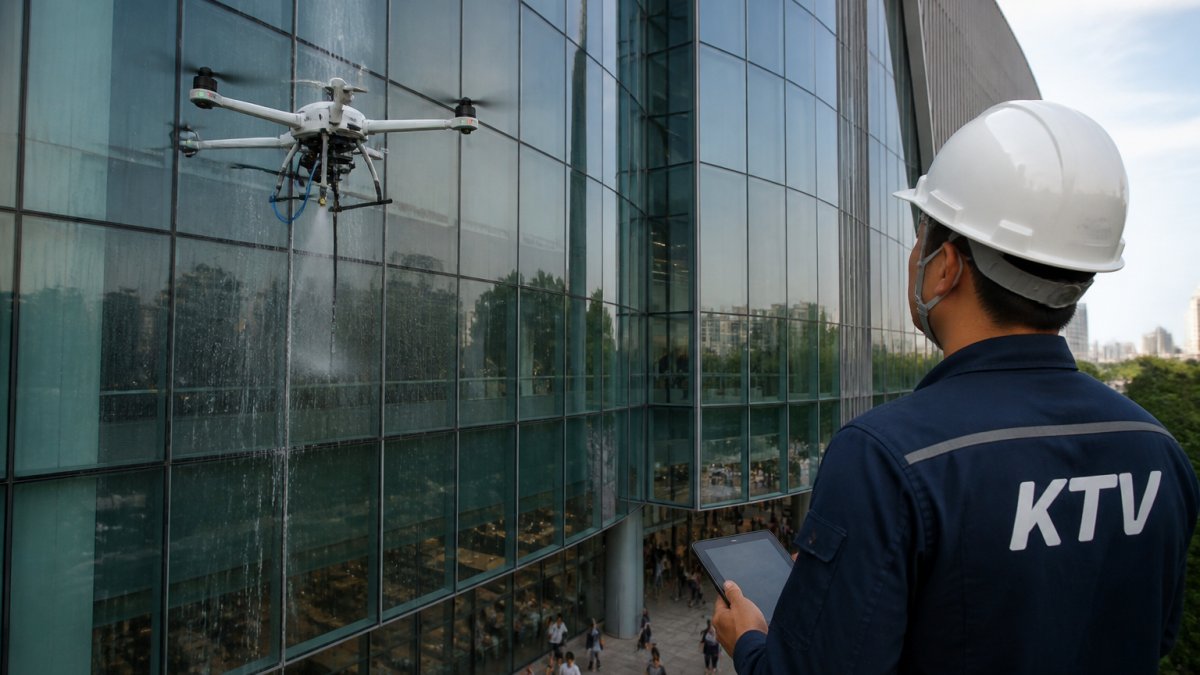
At KTV Working Drone Thailand, our fully autonomous drone systems clean without chemicals and without anyone leaving the ground.
For mall operators, the operational win is scheduling. Cleaning equipment stays off the plaza and the job leaves an auditable digital record of what was cleaned, when and by whom.
Setting a Preventive Facade Maintenance Schedule
A preventive facade maintenance schedule is a calendar that ties each task to a season, a facade zone and a budget line, so work happens before failure rather than after it. Reactive maintenance always costs more, because you pay emergency rates and inherit secondary damage.
A workable annual rhythm for a mall looks like this:
| Task | Frequency | Best timing |
|---|---|---|
| Ground-level visual walk-by | Monthly | Any |
| Glass and curtain wall cleaning | Quarterly | Dry season |
| Sealant and joint inspection | Quarterly | Before rainy season |
| Detailed condition assessment | Annually | Same month each year |
| Gutter and drainage clearing | Before rainy season | Pre-monsoon |
| Repainting or coating refresh | As condition dictates | Dry season |
Build the calendar backwards from the rainy season. Sealant checks, drainage clearing and any coating work should finish before the heavy rain arrives, not during it.
Choosing a Facade Maintenance Provider: Questions That Separate Them
The right provider answers hard questions before you ask them. Most mall operators compare quotes on price per square metre, which tells you almost nothing about safety, documentation or total cost.
Ask every shortlisted provider these:
- What access method will you use for each facade zone, and why?
- Can you show certification and insurance documents for the method and the crew?
- What digital records do we receive after each job?
- How do you handle weather delays and incomplete work?
- Who is liable if a panel or seal is damaged during work?
- Can you provide independently verifiable environmental data for our reporting?
That last question separates serious operators from the rest. If your ESG reporting is externally audited, self-reported figures will not survive scrutiny.
For context on what credible building performance reporting looks like, the GRESB real estate assessment framework sets the standard many institutional landlords now work to.
Budgeting and Measuring Professional Facade Maintenance for Malls
Budget facade maintenance as a lifecycle cost, not an annual expense.
Three numbers drive the budget:
- Access cost: scaffolding and rope access carry setup, dismantling and exclusion-zone costs that drone methods avoid.
- Disruption cost: lost trading hours, blocked entrances and tenant complaints are real costs, even if they never appear on an invoice.
- Deferred repair cost: every year a sealant line is left unaddressed adds to the eventual rehabilitation bill.
Measure service quality with four metrics: inspection frequency against plan, defect response time, re-clean rate and documentation completeness. Review them quarterly with your provider.
Pricing for professional facade maintenance for malls depends on facade area, access complexity, height and scheduling constraints, so we quote per building rather than publishing a rate card.
Frequently Asked Questions
How often should a mall facade be cleaned and inspected?
Most malls benefit from a visual inspection every quarter and a full condition assessment once a year, with cleaning two to four times a year depending on how much dust, rain and traffic the exterior faces. High-traffic entrances and glass curtain walls usually need more frequent attention than rear service elevations. Build the preventive facade maintenance schedule around your own inspection findings rather than a fixed calendar, and shorten the interval after any storm damage or nearby construction work.
Can drones clean mall facades safely?
Yes. Drone facade cleaning keeps technicians on the ground, so nobody works at height on the glass or cladding. A trained pilot flies the drone while a spotter manages the cordon below, and cleaning is done with filtered water rather than chemicals. Before any flight, the provider should confirm pilot certification, insurance, wind limits and a documented facade maintenance safety plan covering shoppers, tenants and loading areas.
How can facade maintenance be carried out without disrupting shoppers?
Plan the work around footfall, not the other way round. Clean entrances and main elevations before opening or after closing, keep service yards and car park ramps for daytime work, and cordon a small zone rather than closing a whole frontage. Drone facade cleaning helps here because setup takes minutes and there is no scaffolding to erect over walkways. Agree the schedule with tenants in advance and share a simple map of affected zones each week.
What should a facade inspection checklist cover?
A practical facade inspection checklist records glass condition, sealant and gasket wear, cladding fixings, panel alignment, water staining, efflorescence, rust streaks and any loose or cracked elements. Add roof-edge parapets, signage mounts, drainage outlets and solar panels if fitted. Photograph every defect with a location reference, rate severity, and set a defect response time. Keep the records auditable so insurers, auditors and asset managers can see the building's condition trend over time.
Mall facades are unforgiving: they punish delay and reward discipline. If your current programme still depends on scaffolding, abseilers and paper sign-off, the risk sits on your balance sheet every day. KTV Working Drone Thailand removes work-at-height exposure entirely with fully autonomous drone cleaning, chemical-free processes that run up to 80% faster, and auditable digital records your auditors can verify. Get a quote and we will map a maintenance plan around your trading calendar.