 How-to
How to Reduce Carbon Footprint in Facility Management
Quick Summary
To reduce a facility's carbon footprint, first measure a baseline of its emissions, then cut energy losses in HVAC and lighting, switch to low-carbon maintenance methods, and rank actions by carbon impact, cost, payback and disruption. Routine monthly checks keep the savings from fading.
- Set the baseline boundary, sort emissions into Scope 1, 2 and 3, and document the emission factors used.
- Match HVAC and lighting schedules to real occupancy hours and service equipment regularly.
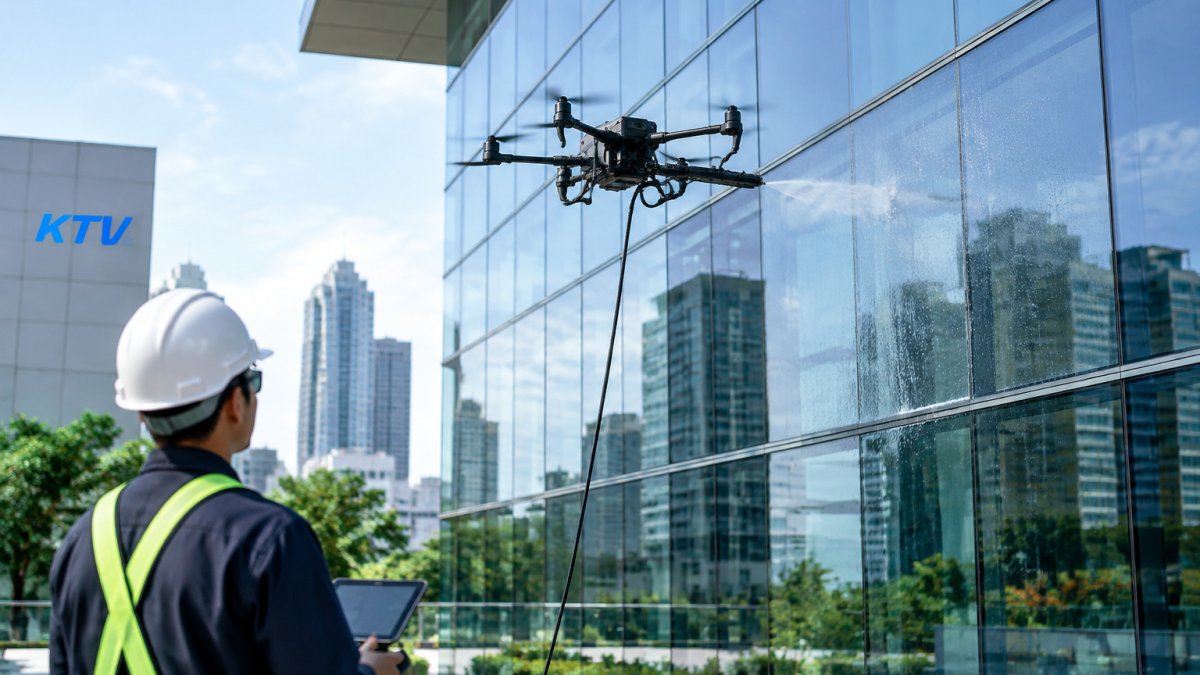
- Drone facade cleaning avoids scaffolding setup and uses no chemicals, reducing fuel use and environmental load.
- Score each action on carbon impact, cost, payback and disruption, then sort into quick wins, planned projects and low priority.
- Review energy and water data monthly and log refrigerant use to catch leaks promptly.
Table of Contents
- Why Facility Management Drives Most of a Building's Carbon Footprint
- Step 1: Measure Your Facility Carbon Footprint Baseline
- Step 2: Cut Energy Efficiency Losses in Facility Management
- Step 3: Shift to Low-Carbon Building Maintenance Practices
- Step 4: Prioritize Actions by Cost, Payback and Carbon Impact
- Step 5: Build Facility Sustainability Best Practices into Daily Operations
- Your Next Step: Verify Savings and Plan the First 90 Days
- Frequently Asked Questions
Why Facility Management Drives Most of a Building's Carbon Footprint
Last Updated: November 8, 2026
Facility management sits at the center of a building's carbon footprint. Heating, cooling, lighting, water systems and maintenance choices decide how much carbon a property releases each year.
Exterior maintenance decisions add up across a building's year.
Carbon footprint in facility management is the total greenhouse gas emissions produced by running and maintaining a building. This includes electricity, gas, refrigerants, transport, waste and purchased services.
- Energy use is often the largest share, from HVAC and lighting.
- Maintenance activity adds emissions through equipment, vehicles and materials.
- Refrigerants can have a high climate impact even in small amounts.
- Waste and water add emissions through disposal and treatment.
This guide walks through five practical steps. You will measure your baseline, cut energy losses, shift to low-carbon maintenance, rank your actions and build habits that last. Each step is written so a facility team can start this month.
Step 1: Measure Your Facility Carbon Footprint Baseline
You cannot reduce what you do not measure. A baseline is the starting number that shows how much carbon your facility produces today. Every later result is judged against it, so the baseline has to be accurate enough to trust and documented well enough to defend.
Setting the Organizational and Operational Boundary
Before you collect a single meter reading, decide what the baseline covers. The organizational boundary defines which entities are included, a single building, a campus, or a portfolio managed under one contract. The operational boundary defines which emission sources inside that entity are counted.
A common pattern is to set the boundary at the level the facility team actually controls: the building systems, the maintenance activity, and the purchased services specified in the management contract.
- Define the entity: one building, a site, or a portfolio.
- List the systems and services inside the operational boundary.
- Record what is excluded and why (landlord-supplied cooling, tenant equipment, common-area allocations).
- Get the boundary signed off by the person who owns the sustainability or reporting obligation.
Separating Scope 1, Scope 2 and Scope 3 Emissions
Emissions are sorted into three scopes. Scope 1 covers direct emissions from fuel your building burns, such as on-site gas boilers, backup generators and company vehicles. Scope 2 covers emissions from purchased electricity, steam or cooling. Scope 3 covers indirect emissions along the value chain, such as contractor travel, purchased goods, water supply, waste disposal and outsourced operations.
Facility managers usually control Scope 1 and Scope 2 directly, so start there. Scope 3 is harder to measure but can be large, refrigerant leakage, service-vehicle fuel and purchased services are the sources most often missed. Note them now, even if you do not yet calculate them in full, so the baseline file shows what is pending rather than implying it does not exist.
- List every fuel and energy source the building uses.
- Assign each source to Scope 1, 2 or 3.
- Mark the sources you can measure with real data today and those that will need estimation.
Choosing Emission Factors and Handling Estimates
A meter reading gives you activity data, kilowatt-hours, litres of fuel, kilograms of refrigerant. To turn that into carbon, multiply by an emission factor.
Where metered data is unavailable, estimate and label the estimate.
Watch out: mixing metered and estimated data in the same total without labelling which is which makes the baseline impossible to audit and invites disputes when savings are claimed.
Setting Meters, Data Sources and Reporting Intervals
Good data comes from metered readings, not estimates. Install or check sub-meters for major loads like chillers, lighting and lifts. Pull utility bills for electricity, gas and water, and record refrigerant top-ups from service logs.
Choose a reporting interval that matches your decisions. Monthly data is fine for trends, while weekly or daily data helps you spot waste quickly. Keep one shared spreadsheet or dashboard so the whole team works from the same numbers, and record the baseline year, the boundary, the factor sources and the data gaps in a short methodology note.
Step 2: Cut Energy Efficiency Losses in Facility Management
Energy efficiency is usually the fastest route to a lower carbon footprint. Less wasted energy means less fuel burned and lower electricity demand.
Energy efficiency in facility management starts with the systems that run the most hours.
- Set schedules. Match HVAC and lighting to real occupancy hours.
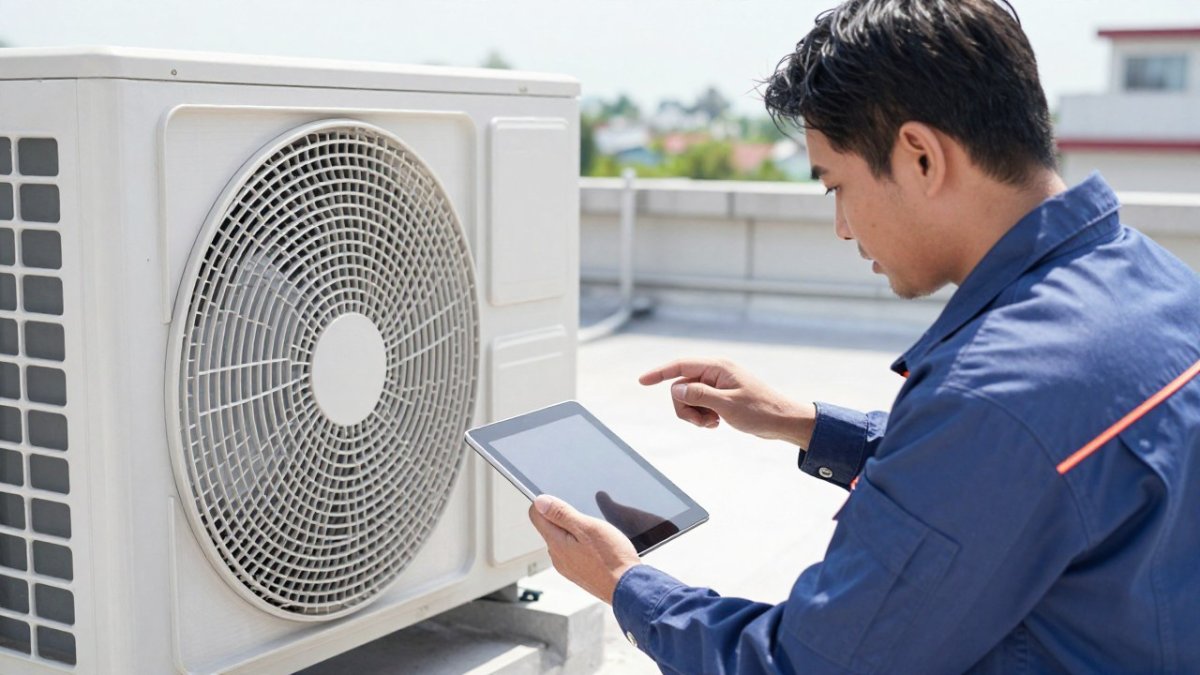
- Service equipment. Clean filters and coils to keep fans and compressors efficient.
- Seal and insulate. Check door seals, window gaps and duct leaks.
- Upgrade lighting. LED fittings with occupancy sensors cut lighting energy sharply.
Solar output is another loss point. Dirty panels can lose meaningful production, and soiling builds up in dusty or humid conditions.
Watch out: an energy audit that stops at the report produces no savings. Assign one owner and one deadline to every fix.
Step 3: Shift to Low-Carbon Building Maintenance Practices
Maintenance itself produces emissions, so how you maintain a building matters. Scaffolding, cranes and work trucks burn fuel. Frequent manual cleaning can also drive up waste and chemical use.
Low-carbon maintenance means choosing methods that do the same job with less fuel, less waste and less risk.
Compared with traditional methods, drone facade cleaning avoids the setup and teardown of scaffolding and cuts the time spent on site. Compare drone and scaffolding, abseiling and skylift methods for Bangkok high-rises It also uses no chemicals, which reduces the environmental load of the cleaning itself. Our Drone Facade Cleaning vs Traditional Methods guide compares the two approaches side by side.
When you evaluate any maintenance method, ask these questions:
- How much fuel and transport does the method need?
- Does it use chemicals or water that need treatment?
- How much waste does it create?
- Does it reduce risk to workers and building surfaces?
Step 4: Prioritize Actions by Cost, Payback and Carbon Impact
You will likely find more carbon-saving ideas than you can act on. Prioritization keeps the team focused on the actions that deliver the most reduction for the money, and it gives finance teams a defensible order of work rather than a wish list.
Scoring Each Action on Four Measures
Score every candidate action on four measures, not three. Carbon impact is the tonnes of CO2 equivalent it avoids each year. Cost is the upfront investment, including installation, downtime and any training. Payback is how long the savings take to repay that cost. Operational disruption is the practical burden, access requirements, shutdown windows, tenant impact and the staff time needed to implement and then run the change.
Disruption matters because two actions with identical payback can have very different real-world feasibility. A chiller replacement and a scheduling fix may both pay back in three years, but only one can be done without a plant shutdown. Scoring disruption separately stops the team from approving a technically attractive project it cannot actually deliver.
- Carbon impact: annual tonnes of CO2e avoided, using the same emission factors as the baseline.
- Cost: total upfront spend in THB, including installation, downtime and training.
- Payback: upfront cost divided by annual savings, expressed in years.
- Disruption: access, shutdown, tenant impact and staff time, rated low, medium or high.
Normalizing Actions with Different Lifetimes
A LED retrofit may last fifteen years while a controls tune-up may need revisiting every two. Comparing them on payback alone favours the short-lived action even when the long-lived one delivers more carbon reduction per baht over its life.
Where an action also reduces operating cost, count the saving in THB. Where it only reduces carbon without a cost saving, refrigerant leak repair, for example, record it as a carbon-only action and rank it separately so it is not crowded out by projects with attractive financial returns.
Sorting into Three Groups
Write each action on a card with its four scores and its cost per tonne over life. Sort the cards into three groups.
- Quick wins: low cost, short payback, meaningful carbon impact and low disruption. Start here.
- Planned projects: higher cost or higher disruption but strong carbon impact per baht over life. Schedule these in the capital plan with a named owner and a target quarter.
- Low priority: high cost, small carbon impact or very long payback. Revisit later or drop.
A common pattern is that quick wins fund the credibility needed to approve planned projects: the first measured savings give the finance team evidence that the larger business case is realistic.
Watch out: scoring actions in isolation lets each owner inflate their own project's carbon impact.
Turning the Ranking into an Investment Plan
The output of this step is not a list, it is a sequenced plan. For each quick win, record the owner, the budget in THB and the completion date. For each planned project, record the approval route, the capital year and the expected annual reduction in tonnes of CO2e.
The article scores each candidate action on four measures before sorting them into groups.
| Measure | What it captures | How it is expressed |
|---|---|---|
| Carbon impact | CO2e avoided per year | Annual tonnes of CO2e |
| Cost | Upfront investment | Total spend in THB |
| Payback | Time to repay the cost | Upfront cost divided by annual savings, in years |
| Disruption | Operational burden | Rated low, medium or high |
Step 5: Build Facility Sustainability Best Practices into Daily Operations
One-time projects fade without routines. Facility sustainability best practices need to become part of how the team works every day.
Build a short set of recurring habits and assign an owner to each one. Keep them simple enough that they actually happen.
- Review energy and water data every month and act on outliers.
- Check HVAC schedules after any change in occupancy.
- Log refrigerant use and fix leaks promptly.
- Route waste to recycling and track diversion rates.
- Include carbon criteria when buying equipment or services.
Recording these habits also prepares you for reporting. Clean records make audits faster and reduce disputes over data.
Your Next Step: Verify Savings and Plan the First 90 Days
Savings only count when you can prove them. Compare each post-change reading against your baseline, adjusting for weather and occupancy so you do not credit savings that came from a mild month.
Use the first 90 days to lock in the quick wins, set up your data routine and schedule the planned projects. Contact KTV Working Drone Thailand for a quote tailored to your building, with pricing depending on scope, site access and schedule.
Frequently Asked Questions
How can facility managers reduce a building's carbon footprint?
Start by measuring a baseline from utility bills and meter data, then rank actions by cost, payback period and carbon impact. Energy efficiency upgrades in HVAC and lighting usually deliver the largest early reductions, while maintenance scheduling and better procurement add further savings over time. Track results monthly against the baseline so each change can be verified rather than assumed. Costs vary with building size, equipment age and contract terms, so obtain site-specific quotes before committing budget.
How do you measure a facility's carbon footprint?
Collect twelve months of electricity, fuel, refrigerant and water data, then convert each into carbon dioxide equivalent using published emission factors. Group the results into Scope 1 (direct fuel and refrigerant emissions), Scope 2 (purchased electricity) and Scope 3 (contractors, waste and purchased services). Record the calculation method and data sources so auditors and stakeholders can follow the figures. Smart meters make the process faster and more accurate than manual estimates.
Can exterior building cleaning reduce a facility's environmental impact?
It can, mainly by changing how the work is done. Methods that avoid scaffolding, heavy vehicles and chemical runoff reduce emissions and waste linked to the job. Autonomous drone-based cleaning is one approach that can reduce work-at-height access equipment, though its emission savings should be verified against your own baseline and the provider's documented data before you rely on them in reporting.